- The Significance of the First IB Teacher Training Program at a Women’s University
- How Changes on the “Teaching Side” Alter the Value of the “Learning Environment”
- The “Professionals” You Meet at International Schools in Malaysia
- Education is an “Investment in Human Capital,” Not “Consumption”
- Education Migration as “Family Strategy” and the Concrete Costs
- Don’t Miss the Signs of Change. That’s the Start of Family Strategy.
The Significance of the First IB Teacher Training Program at a Women’s University
Hello. I’m Saori, living in Penang, Malaysia, sharing the realities of education migration while raising three children.
The other day, an interesting piece of news caught my eye.
For the first time at a women’s university in Japan, a department corresponding to an IB (International Baccalaureate) teacher training program is being established.
When I saw this news, I was struck.
I felt this was a “signal” for affluent families considering education migration.
Because this news indicates that the supply side of “education” is undergoing a major change.
And that change becomes crucial information when we view our children’s education as an “investment.”
How Changes on the “Teaching Side” Alter the Value of the “Learning Environment”
My eldest daughter Hikari and eldest son Zen attend an international school in Penang.
My younger daughter Yukari is only one and a half and doesn’t go to school yet.
Through my children’s school life, I feel strongly about one thing.
That the biggest factor determining the quality of education is not the “curriculum” but the “people.”
Even with a globally recognized program like IB, its value is halved if not accompanied by high-quality teachers.
The establishment of this IB teacher training program at a women’s university is likely proof that Japan is finally getting serious about cultivating “high-quality IB educators” domestically.
However, let’s think about this.
It will take years for the teachers trained in this program to become fully effective in the classroom.
Furthermore, it will take even more time for this to spread and take root nationwide.
Parents of our generation considering education migration must seriously confront this “time lag.”
A child’s growth waits for no one.
The period from ages 3 to 12, when language acquisition and foundational thinking skills are most flexible, is truly the “golden time.”
Where and to whom should we entrust this precious time?
The “Professionals” You Meet at International Schools in Malaysia
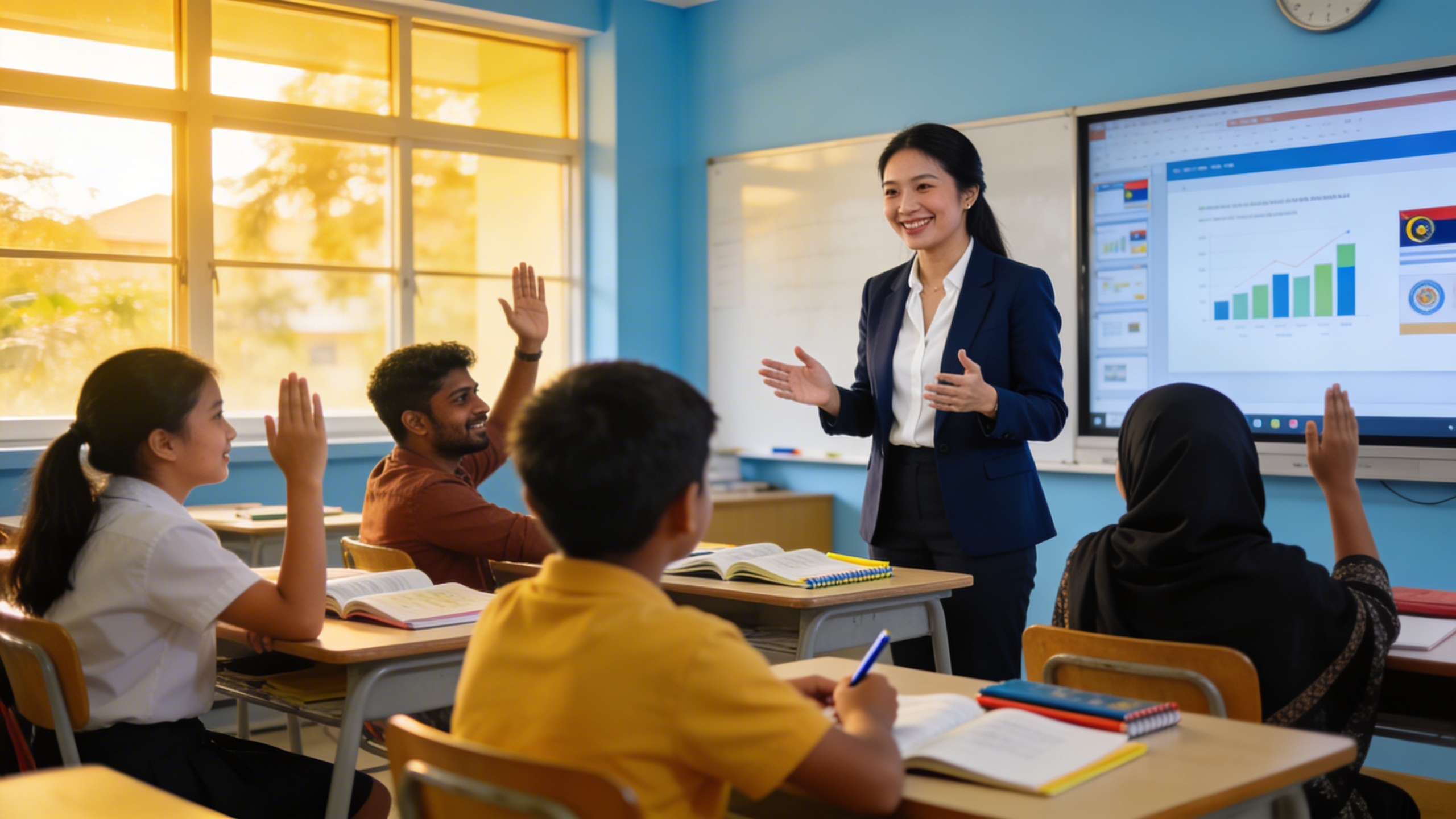
The teaching staff at my children’s school are truly multinational.
They gather from all over the world: the UK, Australia, Canada, South Africa, and more.
Many of them have long careers in teaching IB or IGCSE.
They are not just people who “know” the program; they are professionals who have “practiced” it for years, sometimes decades.
Hikari’s homeroom teacher taught IB in the UK for over 10 years, then came to Malaysia via Singapore.
In her class, she doesn’t just cram knowledge; she asks, “Why do you think that?” encouraging the children to think for themselves.
This is the essence of IB’s “inquiry-based learning,” realized only through a teacher’s deep experience and understanding.
I believe one core aspect of education migration lies in access to this “human capital.”
The movement to cultivate high-quality IB educators in Japan is very welcome news.
However, we have the choice right now to take our children to places where a mature international education environment and teachers who have honed their skills there for years already exist.
Education is an “Investment in Human Capital,” Not “Consumption”
Here, let’s recall our core philosophy, as stated in our editorial policy.
Education migration is not a luxury; it is a rational hedge against structural risks in Japan.
To view education not as “consumption” but as “investment.”
To redefine it as part of a family strategy to maximize a child’s human capital.
This recent news seems to support this way of thinking.
The fact that Japan is finally moving to train full-fledged IB teachers suggests, conversely, that there has potentially been a shortage of “human capital” in this field until now.
What we in the affluent and business-owner class should be most sensitive to is this “gap.”
If there is a temporal and spatial gap between a world-standard education program and the sufficient human resources, both in quality and quantity, to execute it, then the action to bridge that gap is a rational investment decision.
A place like Malaysia is one “solution” to bridge this gap.
Because you can position your child within an already established international education ecosystem.
Education Migration as “Family Strategy” and the Concrete Costs
Education migration is not a choice made for just one child.
It is a major decision for the operation of the entire family—what you might call “family strategy.”
This is why IB is said to test not just a child’s “innate ability” but also a family’s overall “operational capability.”
It has been over three and a half years since our family moved to Penang.
Behind this decision was clear cost calculation.
According to the latest exchange rate information (as of April 9, 2026), 1 Malaysian Ringgit (MYR) = 39.60 JPY.
Based on this rate, let’s consider the tuition fees at an international school in Penang.
The annual tuition at my children’s school, depending on the grade, is roughly between MYR 40,000 and MYR 70,000.
Converting this to Japanese Yen, it’s approximately 1.58 million to 2.77 million JPY (approx. $10,000 – $17,500 USD).
Even compared to tuition at international schools or high-quality private schools in Tokyo or Osaka, this offers very high cost performance.
Furthermore, when considering overall living expenses, this difference becomes even clearer.
Maintaining a high-quality life for a family of five while accessing world-standard education.
This is the practical benefit of education migration to Malaysia.
While waiting for high-quality IB education to become widely available in Japan, your child’s precious growth period will pass by.
Instead, “utilize” an environment that is already complete.
This is nothing other than efficient resource allocation—a concept business owners will readily understand.
Don’t Miss the Signs of Change. That’s the Start of Family Strategy.
The news of the IB teacher training program starting at a women’s university is certainly a positive change.
However, it will be a long road before this change permeates actual classrooms and directly improves our children’s learning experiences.
Those of us considering education migration need to carefully observe such domestic trends while also evaluating our options with a broader perspective.
It is said that Chinese families choose cities for their children’s education, and Jewish people choose countries.
That’s because they view education not merely as school selection, but as the culture and strategy of the family itself.
Our current practice of educating our children here in Malaysia is also based on this philosophy.
The improvement of Japan’s domestic education environment is something to be greatly welcomed.
However, the speed of that improvement does not necessarily match the speed of our children’s growth.
From the perspective of a family strategy to maximize a child’s human capital, provide the optimal environment here and now.
That is the essential meaning of education migration that this news strongly reminded me of.
Why not try reading the daily flow of education-related news not just as information, but as “signals” for considering your own family strategy?
Beyond that, you should see a more certain form of investment in your child’s future.
Comments