Well-Being Life - Education Migration / Blog
IB Opens Doors to Medical School in Japan: A New Exit Strategy for Education Migration
Hello. I'm Saori, living in Penang, Malaysia, and raising three children.
My eldest daughter Hikari and eldest son Zen attend an international school. My younger daughter Yukari is still one and a half years old.
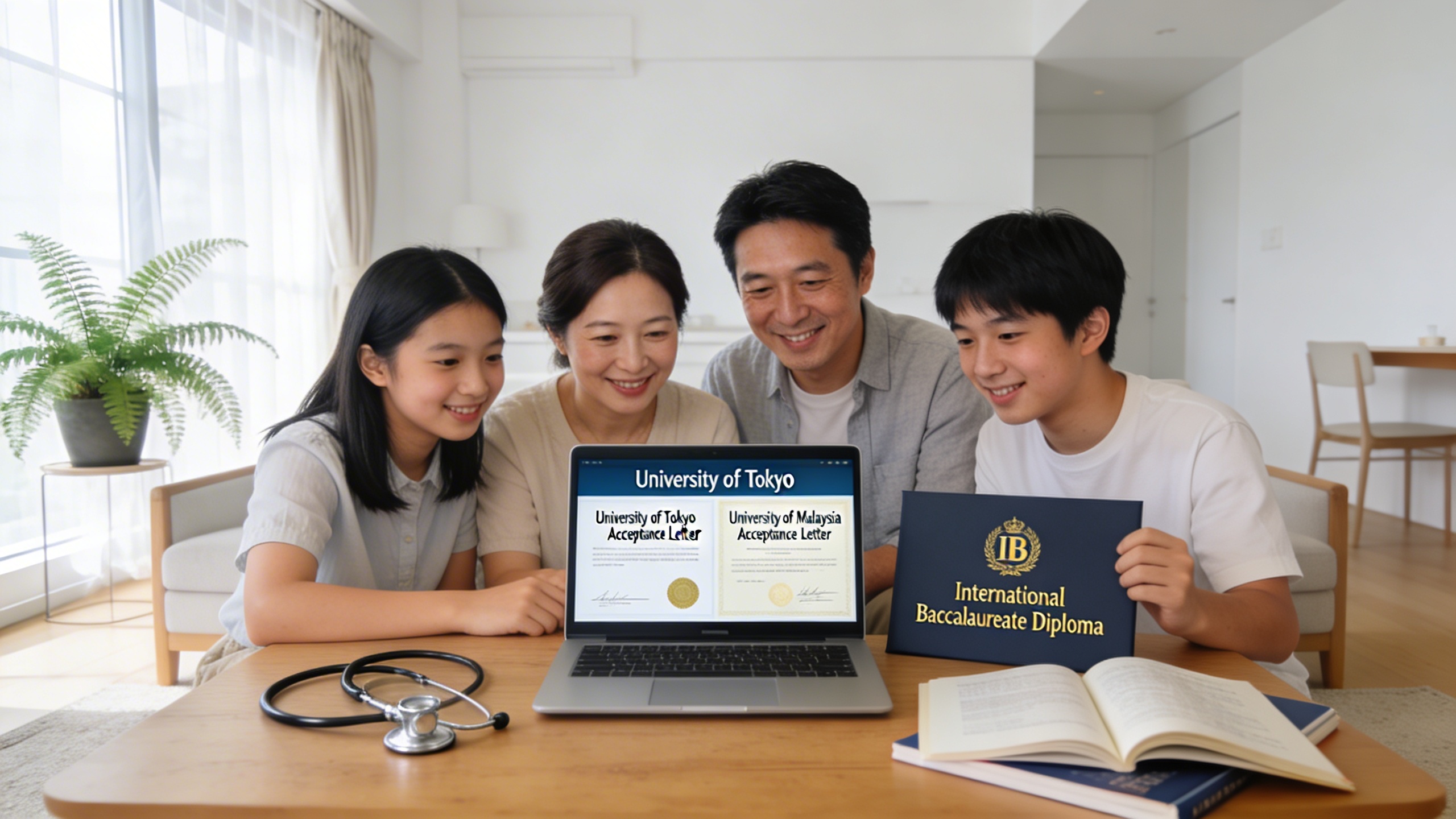
The other day, an interesting news article caught my eye. It was about a student who used their IB (International Baccalaureate) score to gain admission to a medical school in Japan.
This news holds significant meaning for families like ours considering education migration. It means another "exit" option has been added for our children's future paths.
This time, I'd like to use this news as a starting point to think about the strategic value of education migration.
IB Scores Open the Door to Japanese Medical Schools
The news reported that a student from an IB Academy utilized their IB score and successfully entered a medical school in Japan.
This is a groundbreaking change. Traditionally, parents whose children study at international schools overseas faced a certain dilemma.
"We want to expand our child's potential globally. For that, we want them to study an international curriculum like the IB. But, the possibility of eventually returning to Japan is not zero."
Fields involving national qualifications, like medicine or dentistry, were considered particularly difficult. However, this news indicates the situation is beginning to change.
The IB Diploma Programme assesses comprehensive academic ability and inquisitiveness. That score is now being effectively utilized in entrance exams for Japan's competitive universities, even medical schools.
The options for education migration are no longer just a one-way street to "overseas universities." A more flexible choice is becoming possible: "receiving a world-standard education while keeping the path to Japan's top-tier institutions open."
Diversifying "Exits" Increases Asset Value
I view education not as "consumption" but as "investment." And a superior investment is one with high liquidity and multiple exit strategies.
The same goes for investing in a child's education. International qualifications like the IB are precisely "globally recognized assets."
Until now, their value was primarily noted as a passport to overseas universities. However, if they are also recognized by Japan's competitive universities, especially in highly specialized fields like medicine, that changes the game.
The number of places to "cash in" this asset has increased. You could say the liquidity of the investment has improved, raising the asset's intrinsic value.
One reason we chose an international school in Malaysia is the ability to give our children this "global asset." We don't know which country or path Hikari or Zen will choose in the future.
But with a qualification like the IB, their options expand dramatically. This news means the highly advanced and specialized path of "Japanese medical school" has been added to those options.
This is a factor that cannot be overlooked when calculating the return on investment (ROI) of education migration.
The Practical Benefits of Studying the IB in Malaysia
So, why is there value in studying the IB in Malaysia? It lies in cost and environment.
First, please check the exchange rate. 1 MYR = 39.62 JPY (as of April 8, 2026).
At the Penang international school (IB school) my children attend, annual tuition varies by grade. It's roughly between 50,000 MYR to 80,000 MYR.
Calculated in Japanese Yen, that's a range of approximately 2 million to 3.17 million yen. Compared to tuition at international schools within Japan or in Singapore, this offers very good cost efficiency.
At top schools in Singapore, it's not uncommon for tuition alone to cost 4 million to over 6 million yen annually. In Malaysia, you can receive a high-quality IB education for less than half that cost.
Furthermore, Malaysia is a multicultural society. At school, children learn with friends from various nationalities. Hikari's classmates include Malaysian, Chinese, Indian, and Western children.
This environment naturally fosters the "international perspective" and "understanding of diversity" that the IB seeks. Learning isn't just from textbooks; daily life itself becomes a learning ground.
Additionally, the cost of living is lower than in Japan. It's possible to live in a spacious house and hire a helper. This, in turn, reduces parental stress, allowing resources to be redirected towards time with children and investment in their education.
Education Migration is Also "Insurance"
This news can also be seen as a "change" in Japan's educational environment. It's beginning to recognize the value of international educational qualifications.
However, Japan's entire education system may not change dramatically overnight. Structural challenges like a declining birthrate, aging population, and fiscal issues are piling up.
Education migration also has an aspect of being "insurance" against such domestic uncertainties. It's a strategy to diversify a child's potential globally, rather than betting everything on Japan's future.
Even if the choice is made to return to Japan, having a global asset like the IB allows one to start from a high vantage point. This medical school admission case precisely proves that.
Conversely, when choosing to venture out into the world, the IB becomes a powerful weapon. The experience in Malaysia's multicultural environment directly forms the foundation for becoming a global talent.
I believe what we parents can do is prepare the "foundation" and "options" that allow our children to choose freely in the future. Education migration and the IB are one powerful means to that end.
Don't Limit a Child's Future with Borders
Let's say my eldest daughter Hikari decides she wants to become a doctor in the future. If we had continued living in Japan, she would likely aim for the notoriously narrow gate of Japanese medical school entrance exams.
However, if she obtains the IB in Malaysia, her options expand significantly.
1. Use the IB score to apply to Japanese medical schools.
2. Aim for medical schools overseas, such as in Malaysia or Singapore.
3. Study medicine at a university in Europe or America.
4. Study another field first, then pursue medicine later.
The IB curriculum fosters broad liberal arts knowledge and critical thinking skills, rather than specific vocational training. Therefore, even if her interest shifts away from medicine, that foundational ability is applicable in any field.
The important thing is not to determine a child's potential based solely on one country's system or one examination framework. The world offers much more diverse evaluation criteria and opportunities.
Education migration is the first step in bringing a child into that "bigger world" and letting them experience its possibilities.
Conclusion: Flexible Career Planning Creates Family Peace of Mind
The news about entering Japanese medical school via an IB score is one symbolic case. It shows that the intersection between global educational standards and Japan's education system is widening.
For us education migration families, this is encouraging news. It means more "exits" for our children's paths and increased liquidity of our educational assets.
Malaysia is a place where you can acquire that global educational asset (the IB) at a relatively low cost. The multicultural environment gives children valuable experiences beyond just the qualification.
The goal of education migration is not necessarily just "permanently residing overseas." It's also about maximizing a child's options and diversifying risk for the entire family.
Knowing about the career possibilities like those introduced here might change how you view investment in education. Please try designing your child's future with a broad perspective.
Well then, I look forward to seeing you in the next article.