Well-Being Life - Education Migration / Blog
The Real Benefits of Education Migration, Seen at 18 Months
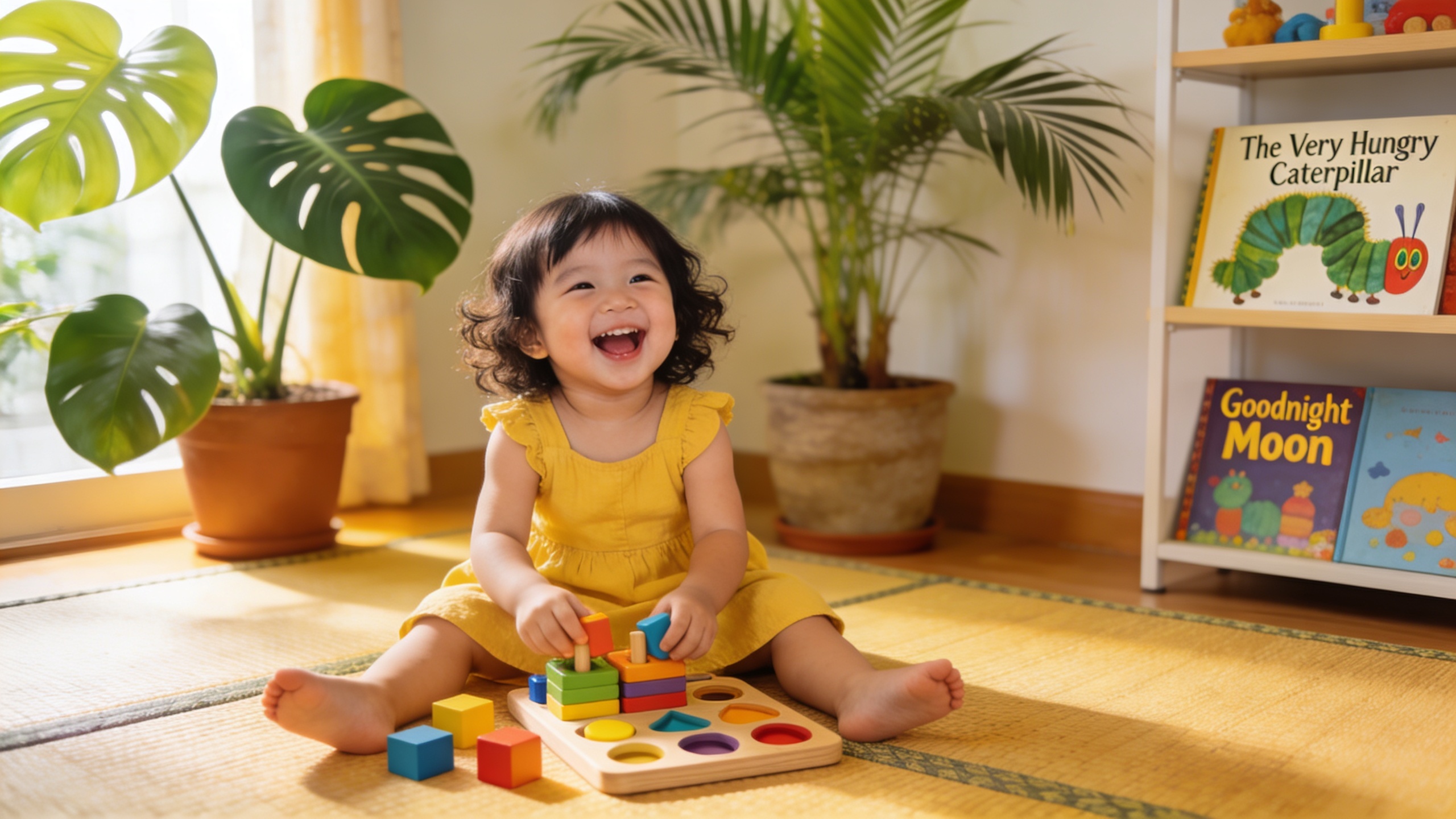
Our Second Daughter’s 18-Month Milestone in Malaysia
Hello, I’m Saori. It’s been three and a half years since we moved to Penang, Malaysia.
We have three children: Hikari (7), Zen (5), and Yukari (18 months). Recently, Yukari celebrated her 18-month milestone.
The older two attend an international school, but Yukari is still at home, spending most of her time with me.
Yet, I’ve realized that this "do-nothing period" is when I truly feel the real benefits of education migration.
Natural Multilingual Exposure in Early Childhood
Hikari and Zen started international school at ages 3 and 2, respectively. Back then, I worried, "Will they really learn to speak English?"
But watching Yukari, I see those worries were unfounded.
At home, I speak Japanese with her, my husband speaks English, and outside, Malay and Chinese fill the air. Yukari isn’t speaking yet, but she quietly listens to Hikari responding in Japanese when I speak English.
The other day, a Malay neighbor greeted her with "Selamat pagi," and Yukari waved back with a smile. She may not have words yet, but the foundation for communication is already there.
The golden age for language acquisition is said to be ages 3 to 12, but the period from 0 to 3 is also crucial for "sound recognition." Whether a baby hears sounds not present in Japanese—like the distinction between R and L, or tonal languages like Chinese—can shape their future pronunciation.
An Environment That Naturally Encourages "Waiting" in Education
In Japan, some children are flagged for "speech delays" at their 18-month checkup.
But in Malaysia, there’s no pressure for children to meet a "correct" developmental timeline. In a multiethnic society, it’s normal for everyone to grow at their own pace. Since no one rushes them, parents don’t feel anxious either.
As a physical therapist who has observed child development, I can say Yukari’s growth is perfectly average. She started walking at 14 months, which is typical.
But here, the focus is on "individuality" rather than "early or late." This mindset has greatly reduced the pressure of parenting.
How the Older Siblings Shape the Younger One
For Yukari, Hikari and Zen are her greatest teachers.
When Hikari practices writing the alphabet for homework, Yukari grabs a crayon and mimics her. When Zen reads an English picture book, she turns the pages alongside him.
The "everyday learning" of the international school kids naturally becomes part of Yukari’s environment.
What surprised me most was when I saw Yukari say "Thank you." Her pronunciation was still unclear, but it was clearly different from "Arigatou." She must have picked it up by listening to Hikari use phrases learned at school at home.
Viewing the Cost of Education Migration as an Investment
Let’s reconsider the costs of education migration.
In our case, the annual tuition for Hikari and Zen at their international school is about 400,000 MYR. That’s roughly 1,608,000 JPY (as of April 26, 2026, at 1 MYR = 40.21 JPY).
Adding housing and living expenses, our annual spending exceeds 20 million JPY.
You might think, "That’s expensive." But viewing it as an "investment" rather than "expense" changes the perspective.
By growing up in this environment, Yukari’s language acquisition costs approach zero. For the older kids, the costs of English cram schools or international school in Japan are offset by living here as a family.
Moreover, the sense of multicultural coexistence and a global perspective are values that money can’t buy.
Who Should Really Consider Education Migration in Early Childhood?
I’m often asked, "Should we move for education while our child is still young?"
My answer is, "It depends on your family’s situation."
For children aged 0 to 3, the most important thing is a "stable, loving bond with their parents." If parents come to Malaysia only to be overwhelmed by work and environmental changes, it defeats the purpose.
On the other hand, if parents can enjoy this environment, children adapt with surprising ease. Watching Yukari, I see no barriers of language or culture. If anything, she seems to relish the new stimuli.
Conclusion: Education Migration Is About Family Growth
Through Yukari at 18 months, I’ve rediscovered the true benefits of education migration.
It’s about "learning that begins before school" and "an environment that nurtures skills without parental intent."
Of course, I still care about the older kids’ school life and academic progress. But every time I witness one of Yukari’s small, unscripted moments of growth, I feel, "This choice was right."
Education migration is a space for the whole family to grow, not just the children. And being able to start from age zero—that might be the biggest advantage for me.
I’ll keep sharing our real-life experiences as I watch Hikari, Zen, and Yukari grow.