Well-Being Life - Education Migration / Blog
What Comes After "Usable English"? The Essential Conditions for a Successful Education Migration
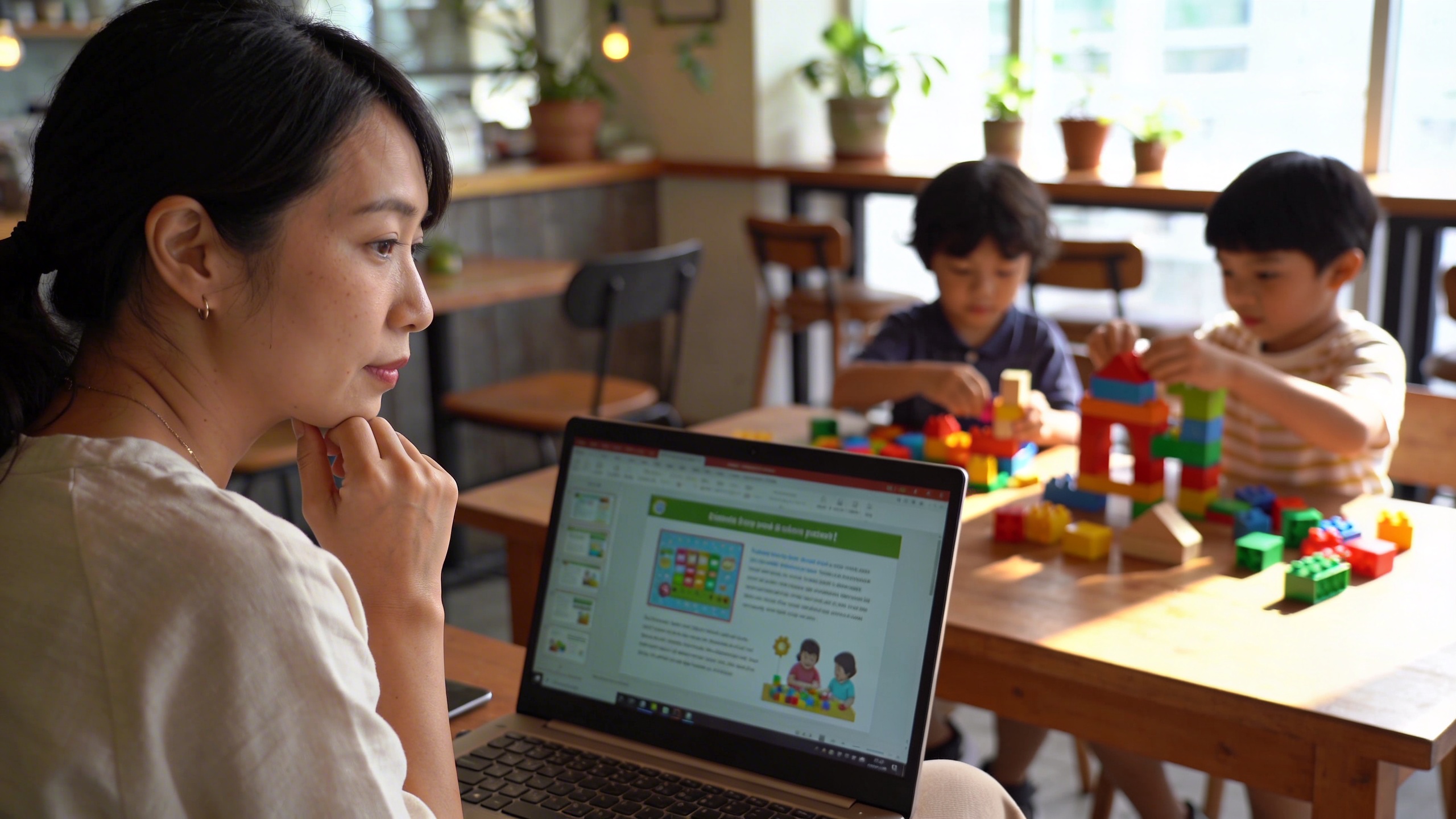
Hello. I'm Saori, raising three children in Penang, Malaysia.
I recently read an article in the Nihon Keizai Shimbun titled, "'We want our children to acquire usable English skills': A family's education migration to Malaysia." It's natural that many families considering education migration first set "English proficiency" as a major goal. When I decided to send my own children to an international school, my expectations for an English environment were also high.
However, after living in Penang for over three and a half years and watching my eldest daughter Hikari and eldest son Zen grow, I've come to a firm belief. Acquiring "usable English" is merely the "first step" in the grand project of education migration. Today, prompted by that article, I'd like to share my family's experiences regarding the more essential "conditions for success" that lie beyond English acquisition.
English is a "Tool," Not the "Goal"
The Nikkei article featured a family who decided to move with the aim of acquiring English skills. Indeed, Malaysia's international schools are an ideal environment for achieving that purpose. Children communicate in English daily with multinational friends. Classes, play, everything is conducted in English.
Looking back to when my eldest daughter Hikari (born 2018) first enrolled, the first few months were memorable as she learned words one by one and gradually began participating in conversations. Now, she has grown to the point where she exchanges jokes with friends in English, reads complex stories in English, and expresses her own opinions in English. Gaining the "tool" of English proficiency is undoubtedly a significant achievement.
But let's think about this. If "being able to speak English" were the sole goal, that might be achievable to some extent through online English conversation or domestic international schools. The meaning of moving the entire family overseas must lie somewhere deeper.
The True Value Lies in Updating the "Operating System" of Thought
What I have realized through my children's education is that the greatest change brought by international education is not the language itself, but an update to the "operating system" of thinking.
To be specific, it's a shift from the "search for the correct answer" thinking often seen in Japanese education to "formulating questions, discussing with evidence, and creating" thinking. In my son Zen's (born 2020) class, even the youngest children are routinely asked, "Why do you think so?" Training to construct one's own thoughts, rather than merely memorizing facts, is embedded in every aspect of play and learning.
This is a fundamental concept of international curricula, including the IB (International Baccalaureate). Language is merely the "application" that runs this new thought process. Even with fluent English, true international competitiveness cannot be achieved unless this "thinking OS" is updated.
The essential success of education migration depends on whether this OS rewrite can happen not just for the child, but for the entire family. We parents also need to update our own ways of thinking and values simultaneously.
Changes in Children to Look for Beyond "English Skills"
So, how does this change in the "thinking OS" manifest concretely in a child's behavior? Here are a few things I've observed in my own children.
Tolerance for "Questions Without Clear Answers"
In the Japanese educational environment, there are many questions with clear answers, as represented by tests. However, in international school project-based learning, children are given questions without single correct answers, such as "How can we make the school more fun?" or "What can we do about environmental issues?" At first, Hikari said, "It feels weird that there isn't just one answer." But now, she enjoys thinking of multiple solutions and comparing their pros and cons. This is an essential ability for future business and leadership scenarios.
Communication Based on an Assumption of Diversity
It's a normal environment where classmates' backgrounds (religion, culture, habits) are completely different. Therefore, they routinely encounter situations where their own common sense doesn't apply. Zen learned to naturally respect when a friend couldn't eat certain foods for religious reasons. This isn't just "good manners"; it's a practical skill in how to collaborate based on an assumption of diverse values.
Self-Advocacy and Negotiation Skills
It's an environment where clearly expressing one's opinion is valued. There are many opportunities to state one's thoughts, whether in class or when deciding game rules, using phrases like "I want to..." or "I suggest...". This forms the foundation for the ability to proactively shape one's environment, rather than being passive.
The Key to Success is the Whole Family's "OS Update"
This is the most crucial point. Even if a child's "thinking OS" changes, significant friction will arise if conversations and values at home remain the same. The success of education migration depends on how flexibly the family can adapt to this change.
Our family also felt bewildered at first. For example, when Hikari passionately talked about environmental issues learned at school and insisted, "We should recycle more at home too." Instead of just ending with "That's great," we listened to the basis of her argument and discussed how to incorporate it as a family within feasible limits. We parents needed to change our position from "the ones who teach" to "partners in learning and discussion."
This process is, in a sense, an education for the parents themselves. For those in management, this "management of value transformation within the family" might feel akin to corporate transformation.
Exchange Rates and Costs: Viewing it as an "Investment" in the OS Update
Of course, obtaining these essential changes comes with a cost. According to the latest exchange rate information (as of April 10, 2026), 1 Malaysian Ringgit (MYR) = 39.76 JPY. Tuition fees for international schools in Penang vary by grade but generally range from about 25,000 MYR to 40,000 MYR per year. Converted to Japanese yen, this is a range of approximately 1 million to 1.6 million yen (approx. $6,300 to $10,100 USD).
If you view this figure as "the cost to acquire English," it might feel expensive. However, if you view it as "an investment to update a child's thinking OS and build their international human capital for the future," the perspective changes entirely. Furthermore, since living costs in Malaysia are lower than in Japan in many aspects, it can be said that an environment is in place to focus resources on educational investment.
The important thing is to define the return on this investment not as "being able to speak English," but as "the thinking skills and adaptability to collaborate with diverse people and create value anywhere in the world." The latter is a core human capability that will not become obsolete, even in the age of AI.
Conclusion: Plan Your Migration with a View Beyond English
The desire expressed in the Nikkei article, "We want our children to acquire usable English skills," is the starting point for many families aspiring to education migration. That is not something to negate. However, clearly envisioning the landscape beyond that is the key to guiding your migration life to success.
Education migration to Malaysia is not merely an extension of language study abroad. It is a journey for the family unit to upgrade the very "system of thought and values" needed to adapt to a new era, in a relatively cost-effective way. Acquiring English proficiency is merely one of the reliable "pieces of equipment" that naturally comes along during that journey.
For those considering education migration, I encourage you to have a deep family discussion around the question: "Once you can speak English, what do you want to do next?" Within that answer, you should find the true meaning of your migration and the sustainable resolve needed.
Our family is also on this journey of OS updating, together with our children. Next time, I hope to share in more detail how this "change in thinking" manifests concretely in the school curriculum and daily assignments.