Well-Being Life - Education Migration / Blog
Sibling Growth Journal: 18 Months Apart at an International School in Malaysia
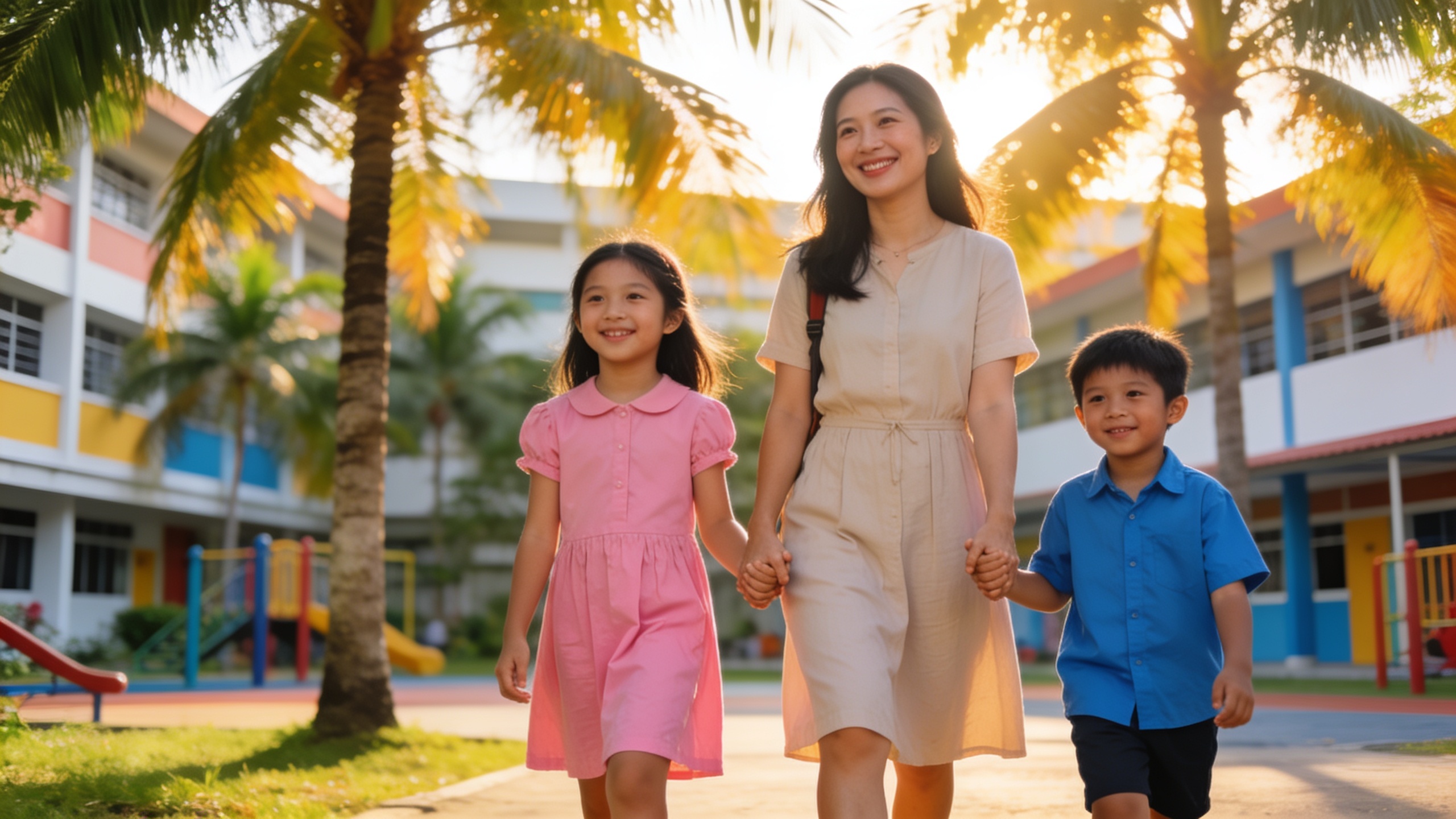
Daily Life at an International School with Siblings
Hello, I'm Saori. It's been over three and a half years since we moved to Penang, Malaysia. My eldest daughter, Hikari, was born in 2018 and is now 7. My eldest son, Zen, was born in 2020 and is 5. Both attend a local international school.
Today, I want to talk about the "differences in growth" and "power of environment" that have become clear as my siblings, 18 months apart, spend their days at the same international school. My youngest daughter, Yukari, was born in August 2024 and is only 1.5 years old, so she doesn't attend school yet. Today's story will focus on Hikari and Zen's experiences.
Same School, Different Classes
Hikari and Zen attend the same international school, but they are in different grades and classes. Hikari is in Year 2, and Zen is in Year 1. Since they are 18 months apart, they might have been in the same grade in Japan, but at international schools, grades are determined by birthdate.
At our school, children born from August to July of the following year are in the same grade. Hikari was born in 2018, so she's in Year 2, and Zen was born in 2020, so he's in Year 1. With about a two-grade difference, they rarely spend time together at school.
Differences Seen During Morning Drop-Off
In the morning, when we arrive at school, Hikari immediately runs off to her friends. She says "Bye-bye" without even looking back, already acting like a big sister. Zen, on the other hand, holds my hand tightly and pleads with his eyes, "Stay with me." Every day, his homeroom teacher comes to pick him up and coaxes him into the classroom.
Even though they were born to the same parents, their personalities and speed of adaptation are completely different. It's obvious, but seeing it firsthand still amazes me.
Differences in Language Acquisition Speed
The pace at which their English skills have developed since starting at the international school also differs greatly. Hikari was 5 when we moved. Her Japanese was fairly solid, but her English started from zero. For the first six months, she could barely speak and probably only understood about half of the teacher's instructions.
However, around the one-year mark, she suddenly started speaking. Now, she laughs with friends in English and completes her homework in English. She also hasn't forgotten her Japanese, so I feel she is developing a good balance as a bilingual.
Zen, on the other hand, was only 3 when we moved. His Japanese wasn't fully established either. But his absorption of English has been astonishingly fast. Phrases that took Hikari six months to learn, Zen mastered in two months. Now, he increasingly mixes English and Japanese when speaking at home.
Age and the Critical Period for Language
It's said there is a "critical period" for language acquisition. The ages of 3 to 12 are when the brain is most flexible for absorbing language. Zen entered the international school right in the middle of this period, which likely made his English acquisition smooth. Hikari is still at an age where she can catch up, but I do notice a difference.
If you are considering an education migration, age is a major factor. If you move when your child is between 3 and 6, they have a high chance of naturally acquiring both Japanese and English. For children 7 and older, conscious effort is needed to maintain their Japanese.
Benefits of Sibling Rivalry
Even though they are in different classes, they spend time together when they get home. While Hikari is doing her homework, Zen says, "I want to do it too," and opens his workbook. Seeing their older sibling naturally instills study habits, which is a huge benefit.
Also, sharing stories about what happened at school provides great motivation. When Zen hears, "Hikari got praised for her presentation today," he says, "I'll do my best too." It feels less like competition and more like they are growing while acknowledging each other.
Important: Avoid Comparing Them
However, it's forbidden to compare siblings. Hikari is Hikari, and Zen is Zen. Even in the same environment, their growth patterns and strengths differ. Hikari loves reading, while Zen is good at active play. I've realized that respecting each child's pace is key to their long-term growth.
As a Factor in Deciding on Education Migration
Finally, some advice for those considering an education migration. If your children have an age gap, the basic rule is to decide the timing of the move based on the "age of the older child." The younger child will naturally adapt to the environment, but the older child takes more time to adjust.
In our case, we moved when Hikari was 5. Looking back, I think it was just the right timing. If we had waited another year, Hikari's English acquisition might have been much more difficult.
The latest exchange rate is 1 MYR = 39.46 JPY (as of June 11, 2026). The annual tuition for an international school in Penang is approximately 500,000 to 800,000 JPY (roughly $3,500 to $5,600 USD). Compared to Japan, you can receive an international education for less than half the cost.
The peace of mind that comes from having siblings attend the same school, and an environment that allows each child's individuality to flourish. If you're thinking about an education migration, please consider it from the perspective of "the overall growth of all your children."