Well-Being Life - Education Migration / Blog
The Shock of a Public IB School: Japan's Education is Changing
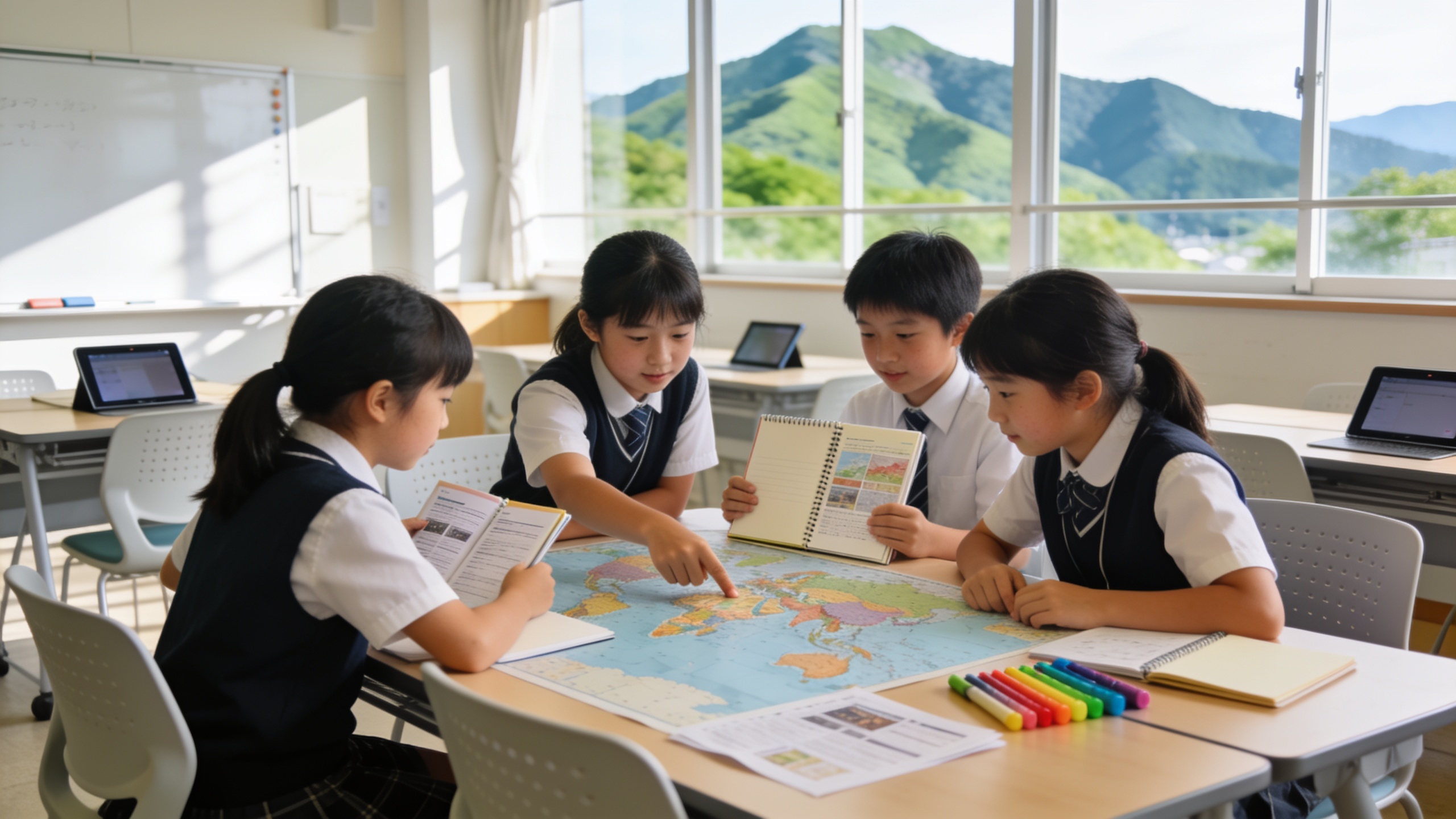
The Shock of a Public Elementary School Earning IB Accreditation
Recently, this news caught my attention: Kochi Prefecture's Kami City Omiya Elementary School became the first public elementary school in Japan to earn International Baccalaureate (IB) accreditation.
Located in a mountainous rural area, far from any big city, this school has officially introduced the IB Primary Years Programme (PYP). I believe this marks a major milestone for Japanese education.
I'm Saori, and I've been living in Penang, Malaysia, for three and a half years. My eldest daughter, Hikari, and my eldest son, Zen, attend an IB school. That's why this news resonated with me so deeply.
It's not just the surprise that "IB is possible at a Japanese public school." Having a real understanding of what IB is all about, I've been reflecting on the deeper meaning of this shift.
The True Nature of "Inquiry-Based Learning" That IB Demands
At Kami City Omiya Elementary, the IB curriculum has been introduced primarily through integrated studies time. Their inquiry-based learning, which leverages local characteristics, was reportedly highly evaluated.
To me, the biggest feature of IB is that it "doesn't give answers." When I observed Hikari's class, the teacher was constantly asking questions: "Why do you think that?" "Is there another way?"
Traditional Japanese education centers on "memorizing the correct answer and reproducing it." But IB is different. It emphasizes "asking your own questions, researching, thinking, and expressing yourself."
This difference greatly impacts a child's flexibility in thinking. Hikari worked on a project where she had to "propose what we can do about the world's water problems."
She's in second grade. Compared to Japanese kids her age, the scale of the themes they tackle is clearly different.
Why Rural Areas Can Excel at IB
What's interesting is that Omiya Elementary decided that being in the countryside wasn't a barrier, but rather an advantage for IB.
The IB PYP takes an approach of "from the local community to the world." You can connect a water quality survey of a local river to global environmental issues. You can think about food problems by interviewing local farmers.
This means that places with preserved nature and strong local communities actually have no shortage of teaching materials, perhaps even more so than urban areas.
Even at international schools in Malaysia, I often see inquiry-based learning themed around Penang's history and culture. The idea is that "knowing your own backyard" is the first step toward international understanding.
Differences Between Japanese Public IB and Malaysian International IB
Now, the inevitable comparison comes down to cost and quality.
Since Omiya Elementary is a public school, tuition is nearly free. On the other hand, annual tuition at IB-accredited schools in Malaysia ranges from about 80,000 to 150,000 ringgit, depending on the school. That's roughly $17,000 to $32,000 USD (based on an exchange rate of 1 MYR = 39.31 JPY as of June 10, 2026).
Some might think, "If you can get IB for free in Japan, why bother moving abroad?"
But here, we need to consider the differences in "IB quality" and the "overall educational environment."
The Language Environment is a Major Factor
Omiya Elementary's IB program is likely conducted in Japanese. In contrast, international schools in Malaysia use English as their primary language.
Since IB assessments are mostly conducted in English, English proficiency is essential for students aiming to earn the IB Diploma in high school.
Hikari and Zen engage in inquiry-based learning in English every day at their international school. They've naturally developed the habit of thinking in English. Overcoming this "language barrier" later in life would require significant effort.
Furthermore, international schools in Malaysia attract children from all over the world. Hikari's classmates come from China, Korea, India, Australia, and many other countries. The experience of debating with peers from diverse cultural backgrounds is something you can't get within the four walls of a classroom alone.
Differences in IB Expertise and Teaching Quality
Another point of concern is the accumulated know-how in IB instruction.
Major IB schools in Malaysia have over a decade of experience. Uplands, for instance, is a prestigious school with nearly 60 years of history. Their teachers are well-versed in IB teaching methods and undergo regular training.
In contrast, Omiya Elementary is the first public school to receive accreditation. They are in a phase of figuring things out as they go. While the Ministry of Education may provide support, the burden on the teachers on the ground is immense.
IB demands not just a curriculum framework, but a fundamental shift in teaching style—from the traditional "teaching" model to a "facilitating" one. This is not something that can be achieved overnight.
A New Option to Consider for Education Migration
That said, I view this news positively. It represents a first step toward change in Japanese education.
If IB spreads to public schools, it will increase educational options. The possibility of "receiving an IB education without relocating" is great news for many families.
However, for now, it's still limited. It will take time for cases like Omiya Elementary to spread nationwide. There are many hurdles to overcome, including teacher training, securing budgets, and gaining community understanding.
For those considering an education migration to Malaysia, I recommend keeping an eye on these developments in Japan while clarifying your family's priorities.
If your needs are strong for "raising children with native-level English proficiency" or "having them thrive in a multicultural environment," international schools in Malaysia remain a compelling option.
If you prefer to "let them learn the basics of IB in Japanese first" or "want to keep costs down," following the trends of Japanese public IB schools could be a good strategy.
Education migration isn't a journey to find the "one right answer." It's a process of continuously choosing the "best solution" for your family. I believe the move toward public IB in Japan is good news that broadens those choices.