Well-Being Life - Education Migration / Blog
Seeds of "Non-Cognitive Skills" Hidden in Penang's Daily Life
Hello, I'm Saori.
The other day, my eldest daughter Hikari (Grade 1) brought home a craft project from school that made me stop and think. It was a simple toy made from a paper cup and rubber bands. But seeing her explain it in English made me realize that her "ability to communicate" had grown without me even noticing.
Today, I'd like to share how "non-cognitive skills" naturally develop through life in Malaysia, based on our family's experiences.
What Kind of Environment Fosters Non-Cognitive Skills?
Non-cognitive skills refer to human qualities that can't be measured by test scores—things like perseverance, curiosity, cooperation, and self-esteem. While this term is often heard in education circles lately, Penang's daily life is full of opportunities to naturally nurture these abilities.
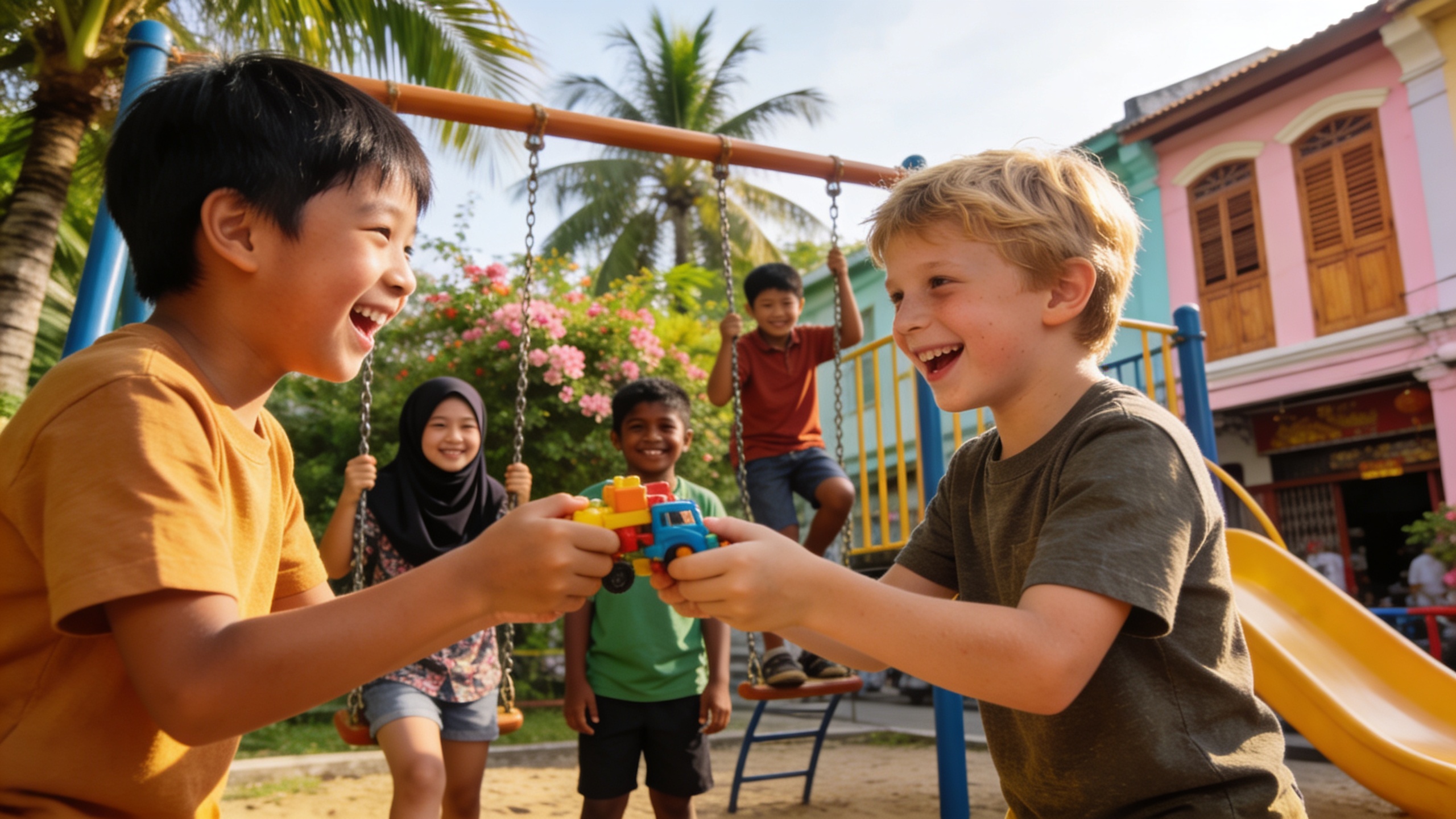
For example, at the international school my children attend, their classes include kids from Malay, Chinese, Indian, Japanese, Korean, and many other backgrounds. Playing with friends who speak different languages and come from different cultures, Hikari and Zen (Kindergarten) have naturally started thinking, "How can I get my point across?"
Communication Skills Born from Language Barriers
Last month, I watched Zen playing with a Malay boy on the school playground. Even though neither of them spoke perfect English, they were happily playing tag using gestures and facial expressions. Watching them, I realized that "the willingness to communicate" matters more than "perfect English."
Back in Japan, because we share the same language, communication tends to rely too heavily on words. But in Penang, the language barrier naturally sharpens the ability to read others' expressions and situations.
"Adaptability" Cultivated in a Multicultural Environment
Walking through Penang's streets, you hear the call to prayer from mosques, catch the scent of incense from Chinese shops, and see the vibrant decorations of Hindu temples. This everyday environment makes "difference" feel normal for children.
At Hikari's school, they celebrate various cultural holidays together—Hari Raya (the festival marking the end of Ramadan), Chinese New Year, Deepavali, and more. Just the other day, she was invited to a classmate's home to celebrate Chinese New Year. There, she learned about receiving "ang pao" (red envelopes) instead of otoshidama (New Year's money), and came home firing off questions like "Why is it red?"
This attitude of researching "why?" on her own or asking friends is exactly one of the non-cognitive skills: intellectual curiosity. It's bound to leave a much deeper impression than learning from a textbook.
A School Culture That Embraces Failure
Another major feature of international schools is a culture that doesn't blame you for mistakes. In Japanese schools, many children feel "embarrassed to be wrong," but at my kids' school, "Try again!" is the motto.
Last week, when Zen got a math problem wrong, the teacher said, "Good try! Let's think together," and worked through it with him. The teacher is actively fostering a mindset that isn't afraid to make mistakes and try again.
This sense that "it's okay to fail" forms the foundation of self-esteem. I hope my children grow up believing that no matter what challenges they face in the future, they can always try again.
"The Ability to Wait" and "Patience" in Daily Life
One skill that's surprisingly honed through life in Penang is "the ability to wait." The sense of time in Southeast Asia is more relaxed than in Japan. You might get caught in traffic during school drop-offs and pick-ups, or wait a long time for your order at a restaurant.
At first, I used to get frustrated, but now I think of it as "part of the education." The children have also found their own ways to spend waiting time—reading books or inventing games with their siblings.
Patience isn't something you can teach at a desk. It's something you naturally learn through life. Penang's "laid-back" sense of time might actually be a valuable learning opportunity for children.
A Habit of Making Non-Cognitive Skills "Visible"
That said, non-cognitive skills are hard to see. In our family, we make time on weekends to share "something we figured out on our own this week."
Last week, Hikari shared how she handled a disagreement with a friend. At school, there was a conflict over role assignments in a group project, but she took the initiative to suggest, "I can do this part. You can do that."
Hearing these stories, I can truly feel her growing. The "life skills" that can't be measured by test scores are steadily developing.
Conclusion: The Real Value of Education Migration
When people considering education migration to Malaysia ask me, "How much will their English improve?" I always say that while English skills are important, what's even more valuable are the non-cognitive skills naturally gained in a multicultural environment.
At the latest exchange rate (1 MYR = 39.73 JPY as of May 6, 2026), international school tuition in Penang ranges from approximately $5,500 to $10,000 USD per year. If this investment helps children gain "human skills" they can use for a lifetime, I don't think it's too high.
Of course, there are struggles with language barriers and cultural differences. But seeing my children go to school with bright eyes every day and share new discoveries with me, I'm convinced we made the right choice.
Education migration is not just an investment in your children—it's a lifestyle choice for the whole family. Why not join us in nurturing these "invisible assets" of non-cognitive skills in Penang's daily life?