Well-Being Life - Education Migration / Blog
How English Skills Grow: Insights from 3.5 Years in Penang
How Our Children's English Has Changed After 3.5 Years
Hi, I'm Saori. It's been three and a half years since our family moved to Penang, Malaysia. My eldest daughter Hikari (born 2018) and eldest son Zen (born 2020) continue attending a local international school. Our youngest, Yukari (born August 2024), is just 1.5 years old and happily spends her days at home speaking Japanese.
The other day, I was amazed by Hikari's English essay she brought home from school. The topic was "My Favorite Place in Penang." She wrote about Batu Ferringhi Beach, where we often go on weekends. The vocabulary and sentence structure were clearly different from just a year ago.
Today, I'll share how our children's English skills have actually progressed, drawing on my perspective as a former elementary school teacher.
The First Six Months Were a "Silent Period"
When we first moved, Hikari barely spoke. She was 5 at the time. In Japanese kindergarten, she had been quite outgoing, but at school, she only nodded in response to the teacher's questions. At home, she'd sometimes tear up and say, "Mom, I don't understand English."
As for Zen, he entered preschool at age 3 and didn't utter a single word for the first two weeks. His teacher told us, "Don't worry. He's in the stage of absorbing information right now."
This "silent period" is a well-known phenomenon in second language acquisition research. When a child who only knows Japanese enters a new language environment, they first focus on listening. It's said to take an average of 3 to 6 months before they start speaking.
In our case, Hikari began speaking English about 4 months later. At first, it was just single words, but by the six-month mark, she could form short sentences.
Penang's Multicultural Environment Boosts English Skills
A key feature of international schools in Penang is the diverse mix of nationalities in each class. Hikari's classmates include Malaysians, Chinese, Koreans, Japanese, Australians, and many others.
This environment naturally motivates children to use English. Whether playing during breaks or working on group projects, the common language is English. Apparently, there are days when no one in her class speaks Japanese.
Her own motivation—"Mom, I want to learn English so I can talk to my friends"—has been more effective than anything else. When she comes home from school, she happily teaches me the new words she learned that day.
Reading and Writing: Home Support Is Key
Conversational skills develop naturally at school, but I feel that home support is crucial for reading and writing.
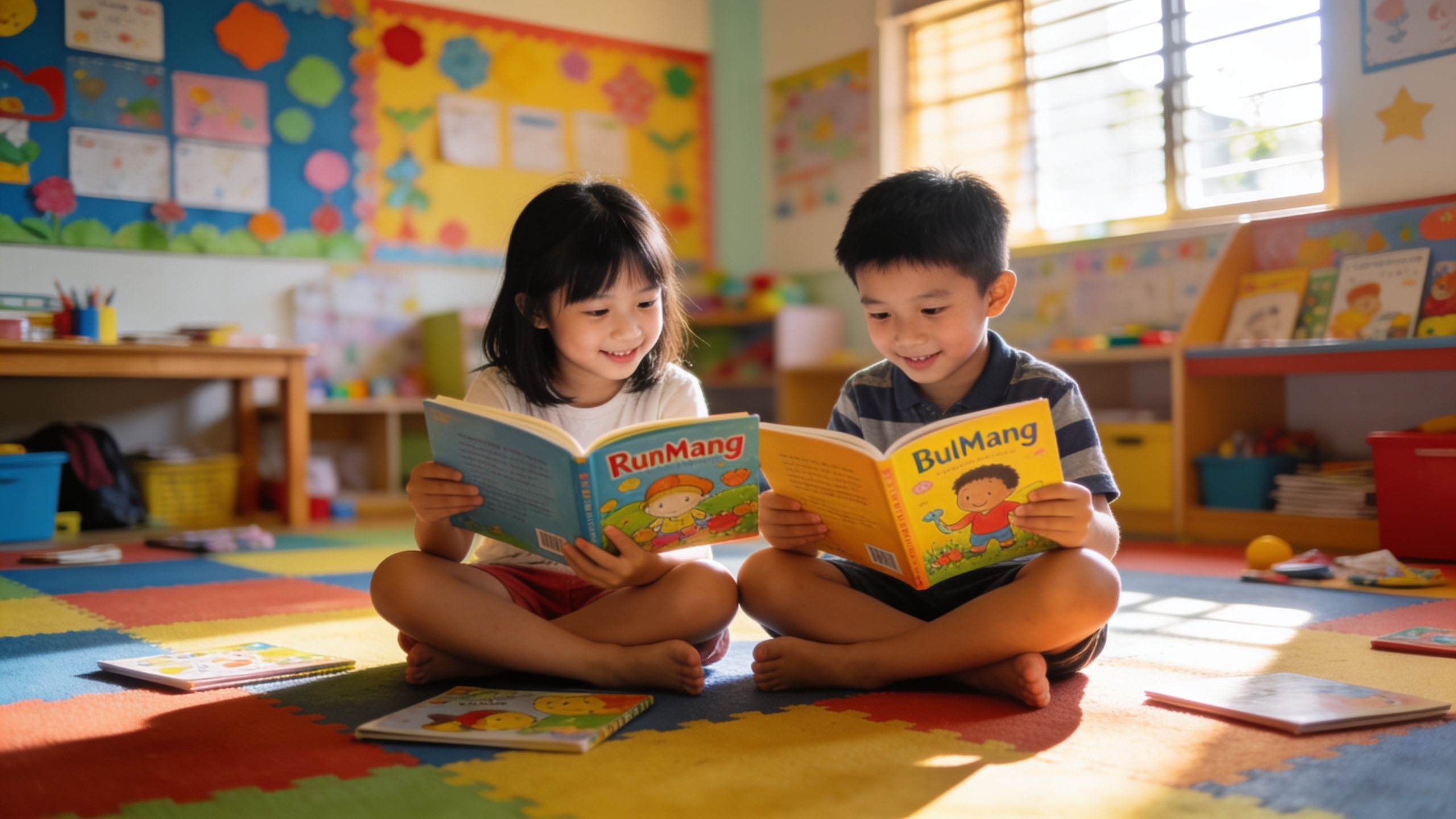
In our home, we set aside 15 minutes after dinner, three times a week, to read English picture books. Recently, Hikari has started reading simple chapter books. Zen still focuses on picture books, but he's beginning to read by recognizing letter sounds.
One teacher advised us, "Make sure to also value time reading Japanese books at home." Apparently, stronger reading skills in your native language (Japanese) have a synergistic effect on English reading comprehension.
Kids Can Thrive Even If Parents Don't Speak English
I myself wasn't confident in my English when we first moved. I'm still studying business-level English, but I've realized that "parents being able to speak English" is not essential for a child's language learning.
What matters is creating an environment where your child can use English and acknowledging their efforts. When she doesn't know a word for homework, we look it up in the dictionary together. Even if I mispronounce something, Hikari corrects me: "Mom, it's read like this." That kind of relationship seems to boost her confidence.
Real Growth in English Skills After 3.5 Years
Currently, Hikari (equivalent to 1st grade) has no trouble with everyday English conversation and can write simple sentences. Zen (equivalent to kindergarten) also plays with friends in English and understands his teacher's instructions.
However, if you're asking whether they've achieved native-level fluency, we're still on the way. Academic vocabulary and complex grammatical accuracy are things that will develop over the next few years.
For those considering a move, I want you to know that children's English progress varies greatly, and the time it takes to adapt to a new environment differs for each child. It's important not to rush and to watch over them with a long-term perspective.
Real Numbers on Education Costs
Let me also share the financial side. Annual tuition at an international school in Penang for lower elementary grades is approximately 40,000 to 60,000 Malaysian Ringgit (1 Ringgit = 39.44 JPY as of June 12, 2026). That's roughly $8,500 to $12,800 USD.
On top of that, there are costs for materials, school bus, and extracurricular activities, but compared to Singapore, Europe, or the US, the cost-performance is very high.
Our family views this expense as an investment in our children's future. Beyond English skills, the flexible thinking nurtured in a multicultural environment and a global perspective are invaluable assets that money can't buy.
Summary: You'll Start Seeing Real Growth Around Year Three
Looking back over 3.5 years, the first year was all about survival and adaptation. The second year brought a bit more breathing room. It was only in the third year that we truly began to see our children's growth.
When people ask, "How long does it take for a child to start speaking English?" my answer is, "Plan for at least three years." Of course, there are individual differences, but I feel that not rushing and respecting your child's pace is ultimately the fastest path.
Life in Penang isn't always easy. But when I see my children happily chatting with friends in English, I truly feel that moving here was the right decision.
I hope this offers some useful insights for anyone considering an education migration.