Beyond Test Scores: The “Real Learning”
Hello, it’s Saori. Over three and a half years have passed since our family moved to Penang, Malaysia. My eldest daughter Hikari (born 2018) and eldest son Zen (born 2020) attend a local international school. Our youngest daughter Yukari is just one and a half, full of energy at home.
The other day, a friend in Japan asked me, “What scores are your kids getting on their tests?” Honestly, the culture at my children’s school doesn’t involve reporting test scores to parents in detail. Instead, teachers frequently share stories like, “Today they worked on this project” or “They collaborated with friends in this way.”
This is the reality of education that cultivates so-called “non-cognitive skills.” Patience, cooperation, curiosity, self-esteem—I feel daily that these invisible abilities are essential for thriving in the future.
Why Non-Cognitive Skills Flourish at International Schools in Penang
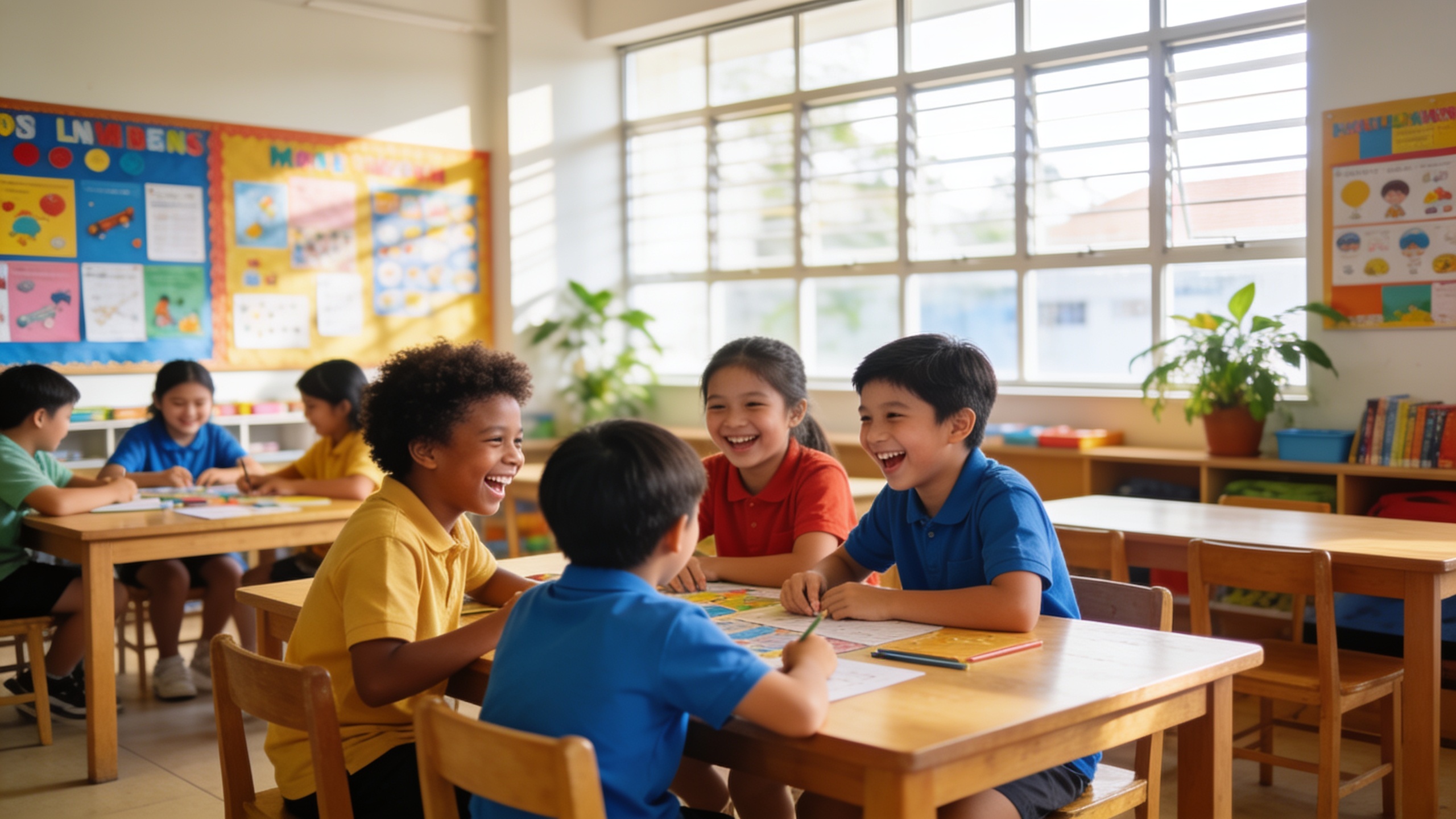
There are several reasons. First, the student body is incredibly diverse. Alongside Malay, Chinese, and Indian students, there are children from Korea, Japan, the West, and beyond. Even with language barriers, communicating through gestures and smiles naturally fosters the ability to “accept differences.”
Teaching methods also differ greatly from Japan. Instead of one-way lectures, group work and presentations are central. Hikari recently worked on a project to “investigate local waste issues and propose solutions.” She researched in the library, conducted fieldwork, debated with friends, and finally presented to the class. This entire process builds patience and cooperation.
An Environment Where “Making Mistakes” Is Part of Learning
Another major difference is the tolerance for “mistakes.” In Japanese education, arriving at the “correct answer” quickly is often valued, but here, the focus is on the process: “Why did you think that way?”
When Zen made a calculation error in math, his teacher said, “The answer is different, but your thinking is interesting. Let’s try another method.” Children learn not to fear mistakes and to keep trying. This accumulation builds the ability to learn from failure—what’s known as “resilience.”
The Relationship Between Non-Cognitive Skills and Academic Performance
Some might think “non-cognitive skills” have nothing to do with academics. However, research shows that children with higher non-cognitive skills tend to improve academically over the long term. Children who can patiently tackle tasks and express their opinions ultimately achieve higher learning quality.
In fact, through school projects, Hikari has developed the habit of looking up words in dictionaries and researching in encyclopedias on her own. Rather than studying for tests, she naturally adopts an attitude of “learning because I want to know.”
The “Survival Skills” Needed in Affluent Parenting
What abilities do business owners and affluent families want their children to acquire? Probably not just knowledge or qualifications. In an era of rapid change, the ability to forge one’s own path, the mental strength to face challenges, and the communication skills to collaborate with diverse people—these are all supported by non-cognitive skills.
Life in Penang provides an environment that naturally cultivates these abilities. Tuition fees are also overwhelmingly reasonable compared to places like Singapore. At the latest exchange rate of 1 MYR = 38.96 JPY (as of June 24, 2026), annual tuition is significantly lower than at international schools in Japan.
How Parents Can Support
That said, we can’t leave it all to the school. It’s important to engage with children at home to foster non-cognitive skills. When my child tries something, I focus on acknowledging the process—”You worked hard!” or “How did you do that?”—rather than the outcome. When they fail, I ask, “What will you do next time?” and think together with them. Even this alone can greatly boost a child’s self-esteem.
Conclusion: A Wealth Beyond Test Scores
When considering an education migration, it’s easy to focus on “school rankings” or “university admission results.” But a child’s life doesn’t end with college entrance exams. What matters more is what they can achieve in the long life ahead.
The non-cognitive skills nurtured at international schools in Penang truly build the “foundation for life.” If you’re considering an education migration, I encourage you to visit a local school. Seeing children learning with such vitality will surely offer new insights.
Until next time.

Comments