Well-Being Life - Education Migration / Blog
What a $35,000 Donation Reveals About the True Value of Music Education
What a Major Donation to Music Education Reveals
Hello everyone, it's Saori.
Recently, I came across news that GOT7's Park Jin-young donated a whopping 5 million yen (approximately $35,000) to commemorate his solo comeback. The funds are reportedly going toward music education for children overseas.
While the amount itself was impressive, what struck me even more was that the donation was specifically earmarked for "music education." When celebrities donate, disaster relief and medical support often take the spotlight. But choosing "music" suggests a deep, personal understanding of how music can transform a life.
As a parent raising children in Malaysia, I've come to deeply appreciate the importance of music education. Today, I'd like to share my experiences.
The Depth of Music Education at International Schools in Malaysia
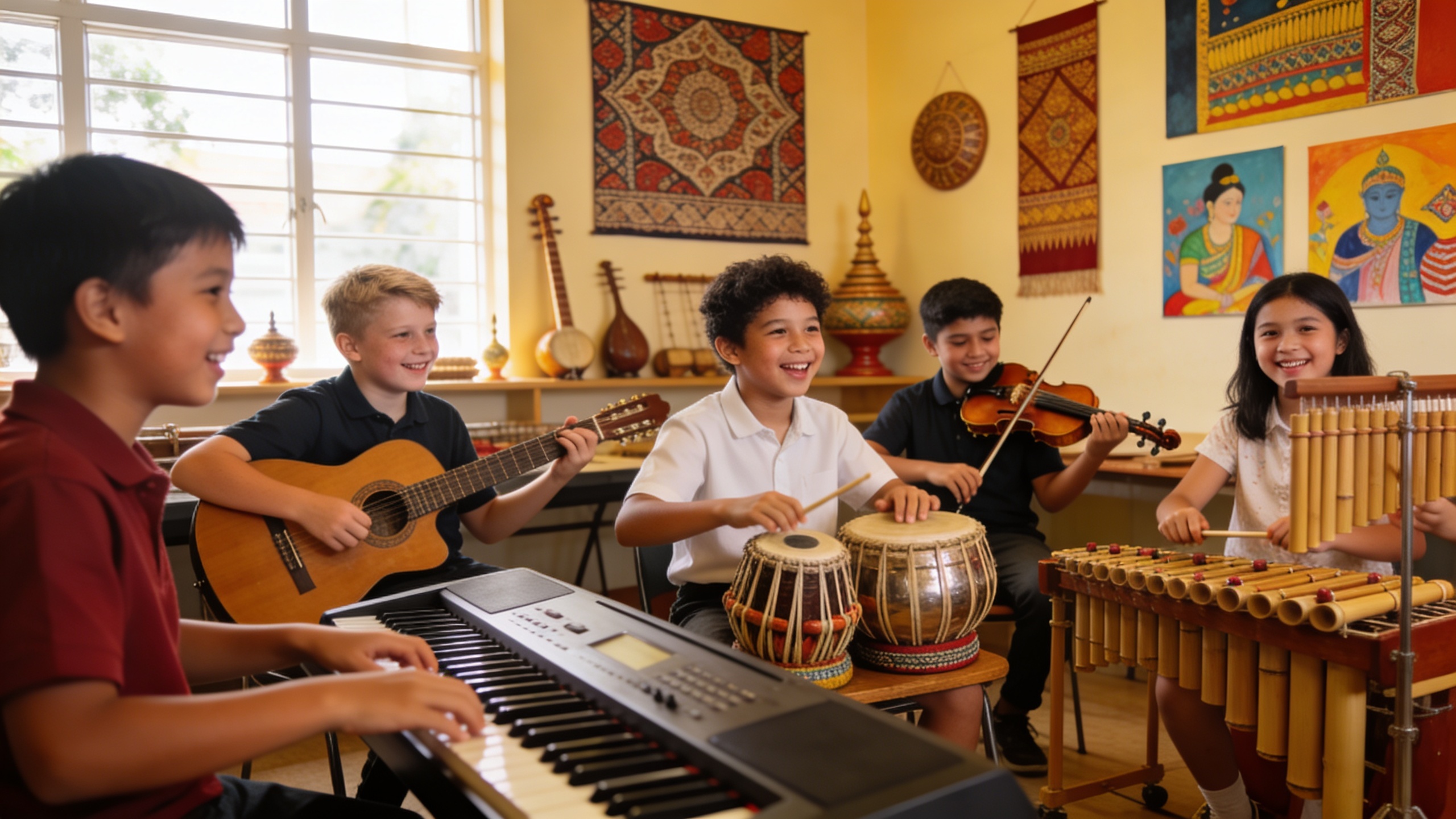
At the international school in Penang that Hikari and Zen attend, music classes are incredibly robust.
While Japanese elementary schools also have music time, here they have classes three to four times a week, and every single student plays an instrument. Hikari started violin last year, and Zen is completely absorbed in percussion.
What surprised me is that music isn't just graded academically; there are also four recitals a year. And these are grand school events that include parents.
Back in Japan, I thought of music as "a hobby." But at this school, music is considered "the core of character development." I feel this difference is huge.
Non-Cognitive Skills Cultivated by Music
Recently, Hikari had her violin recital. She was trembling with extreme nervousness before her performance. Still, her teacher told her, "It's okay, the important thing is to keep going even if you make a mistake," and she played through to the end.
Afterward, she said, "I made a mistake, but I didn't stop. My teacher said that's okay."
This experience is the very essence of the non-cognitive skill of "grit." Not stopping when you fail, but seeing things through to the end. This is something you can't learn from studying at a desk alone.
Furthermore, music also fosters teamwork. In an orchestra or ensemble, trying to stand out alone throws everything off balance. Listening to others and adjusting your own sound – this "listening skill" and "cooperativeness" will be invaluable in any future field.
Considering the True Intent Behind Park Jin-young's Donation
Park Jin-young has lived a life dedicated to music even before debuting with GOT7. For him, music is not just entertainment; it's self-expression and a life force in itself.
That's precisely why I believe he wanted to provide opportunities for children who, due to financial reasons, cannot access music.
This perspective resonates with those of us considering education migration. We tend to focus on "good schools" and "good curricula," but isn't the most important thing "an environment where a child can discover their passion and nurture it"?
The Cost and Value of Music Education
At international schools in Malaysia, music lesson fees are included in the tuition. However, private lessons and instrument rentals come at an additional cost.
In our case, Hikari's violin lessons cost 300 ringgit (approximately $65) per month, and Zen's percussion lessons cost 250 ringgit (approximately $55) per month.
While similar lessons are possible in Japan, a major advantage here is that everything is handled within the school, saving on pick-up and drop-off time, and it's integrated with the school curriculum.
Some might think, "Spending over $50 a month on music is a luxury, isn't it?" But I consider it an investment. The focus, perseverance, and cooperativeness gained through music will undoubtedly benefit their future studies and careers.
The Surprising Connection Between IB and Music Education
I've seen opinions online that "the International Baccalaureate (IB) is meaningless," but I completely disagree.
The IB isn't about rote memorization; it's a curriculum designed to cultivate "inquiry," "critical thinking," and "balanced individuals." And music is integral to all of these.
At Hikari's school, one of the IB units was themed "The Impact of Music on Society." The students composed their own songs, infused the lyrics with messages, and presented them.
This wasn't just a music class. It was a fusion of social studies, language arts, and expression. I felt that music truly embodies the IB's goal of "learning that transcends subject boundaries."
How Music Builds a Child's Confidence
Zen used to be shy about speaking in public. However, after receiving a huge round of applause at his percussion recital, he's clearly gained confidence.
Seeing his eyes light up as he said, "Mom, my drumming was amazing, right?" made me realize the immeasurable power of music.
Park Jin-young's donation is likely an expression of his desire to bring this "confidence that music gives children" to kids all over the world.
Education Migration and Music Options
Malaysia has several international schools that offer serious music education.
Uplands in Penang has a strong music program, including IB Music options. In KL, ISKL and Alice Smith have active orchestras and choirs.
For those considering a specialized music path, conservatories in Singapore or Australia are also viable options. In fact, a senior at our school went on to a music university in the UK from an international school in Malaysia.
When considering education migration, it's crucial to look beyond a school's academic level and consider "what extracurricular activities are available." I firmly believe that music, in particular, is a highly cost-effective investment that simultaneously nurtures a child's sensitivity and non-cognitive skills.
Conclusion: Music is an Investment, Not a Luxury
Park Jin-young's $35,000 donation has once again brought the value of music education into the spotlight.
As parents, we tend to focus on visible results like "they can speak English now" or "their math scores improved." But the "invisible power" that music provides is the very foundation that enriches a child's life.
For those considering education migration to Malaysia, I encourage you to add "the richness of music education" to your criteria for choosing a school. You're sure to discover new possibilities for your child.
Until next time.