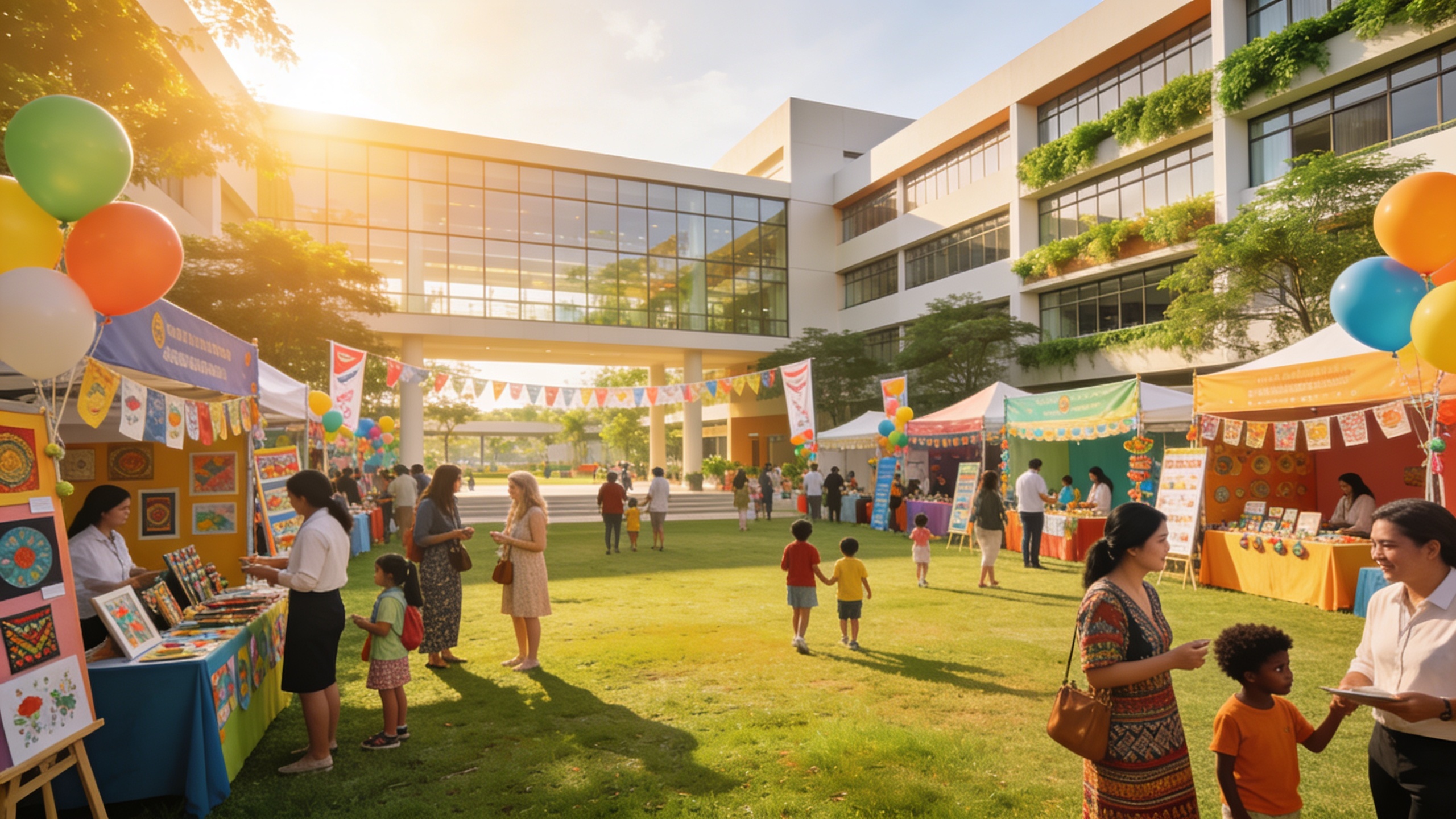
Top Southeast Asian Schools Under One Roof
Recently, news came in that XCL Education, a top international school group in Southeast Asia, would hold a joint information session for three of its schools. XCL Education is a leading education group in Asia with campuses in Singapore and Thailand.
My family lives in Penang, Malaysia, but when considering an education migration, many families also look at schools in Singapore and Thailand. In fact, I often hear people around me saying, “We’re comparing international schools in Singapore.”
A “joint information session” where multiple schools share information simultaneously is incredibly valuable for parents. This is because it significantly reduces the time and cost of visiting each school individually.
Why Joint Information Sessions Matter
When considering an education migration, choosing a school is one of the most important decisions. However, much of the information about international schools can only be obtained by actually visiting them.
Comparison Efficiency Skyrockets
At a joint information session, you can compare the curricula and educational philosophies of multiple schools at once. For example, XCL Education’s three schools—XCL American Academy and XCL World Academy in Singapore, and XCL International School, Thailand—each have distinct characteristics.
What does each school value? How do their admission criteria differ? Being able to gather this information in a short time is a huge advantage for busy business owners.
Get a Feel for the Real Atmosphere
The “vibe” of a school is something that websites and brochures can’t convey. At these sessions, you have the chance to speak directly with actual teachers and staff. I remember that before moving to Penan, my family attended several school information sessions, and the impressions we got on the spot were the deciding factor.
Especially when Hikari first started school, our biggest concern was, “Do the teachers truly care about the children?” Watching how the teachers interact at a session naturally reveals the school’s culture.
Key Points My Family Prioritized in School Selection
When I was choosing schools for Hikari and Zen, I focused on the following three points. I hope this helps those planning to attend information sessions.
Future Planning with the Curriculum
International school curricula vary widely, including IB (International Baccalaureate), IGCSE, and American curricula. As with XCL Education, even within the same group, different schools may offer different curricula.
My family focused on the IB. The IB is a well-established pathway to top universities worldwide, broadening your child’s future options. It’s important to take a long-term view and determine which curriculum best suits your child’s aptitude and goals.
Language Environment and Support Systems
For children whose first language isn’t English, language support after enrollment is critical. When we first moved, Hikari often struggled with English. Good schools have robust EAL (English as an Additional Language) programs.
At information sessions, I recommend specifically asking, “What support is available for children with limited English?” The concreteness and enthusiasm of the staff’s answers can reveal the school’s true commitment.
Community Atmosphere
School isn’t just a place for children. The network among parents also greatly affects the quality of life abroad. At information sessions, you can also gather a lot of information from conversations with other attendees.
Living in Penang, I’ve realized how reassuring it is to connect with families in similar situations. An important criterion in choosing a school is whether it’s a community where your family can comfortably fit in.
How to Use the Information from the Session
After attending a joint information session, be sure to organize the information and take time to discuss it as a family. After visiting multiple schools, I always made it a point to separate “gut feelings” from “objective data” when discussing with my husband.
Also Consider the Latest Exchange Rates
When considering the cost of education migration, exchange rates cannot be ignored. As of May 25, 2026, 1 Malaysian Ringgit is 40.11 Japanese Yen. When comparing with Singapore or Thailand, calculating tuition and living costs based on this rate allows for more realistic decision-making.
In particular, international schools in Singapore have annual tuition fees of around 2.5 to 3.5 million yen (approx. $17,000-$24,000 USD), which is higher than the 800,000 to 1.5 million yen (approx. $5,500-$10,000 USD) in Malaysia. It’s important to create a long-term financial plan that accounts for the risk of exchange rate fluctuations.
Conclusion: A First Step in Information Gathering
XCL Education’s joint information session is an excellent opportunity to efficiently compare top schools in Southeast Asia. If you are seriously considering an education migration, start by attending such an event.
Listen to the talks, feel the atmosphere, and get your questions answered on the spot. This accumulation of experiences leads to a school choice you won’t regret. It’s been three and a half years since my family moved to Penang, and both Hikari and Zen are enjoying school life. I hope your education migration is a fruitful experience for both your children and your family.

Comments