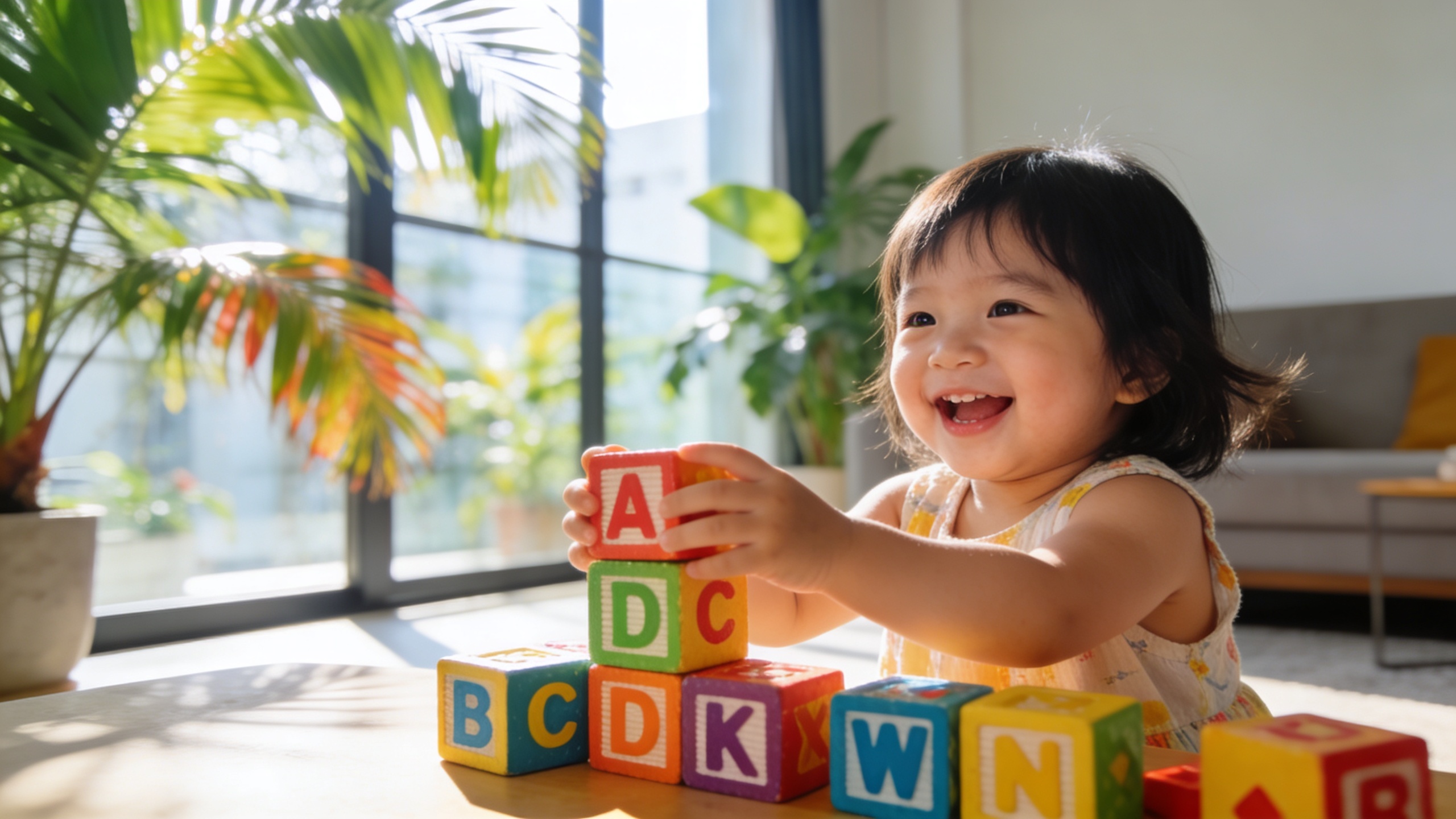
Today, I want to talk about the language development of my second daughter, Yukari (born August 2024, now 1.5 years old).
Vocabulary Growing at an Amazing Speed
Yukari has recently started speaking. She’s still at the single-word level, but her vocabulary is growing rapidly.
What’s interesting is the mix of languages she uses. “Mama” and “Papa” are Japanese. “Nun” (milk) is Malay. “Apple” is English. It feels like she’s just blurting out words without organizing them by language.
My eldest daughter Hikari (born 2018, now in 2nd grade) and son Zen (born 2020, now in kindergarten) went through a similar process. Back then, I worried they might get confused, but now both can switch between Japanese and English depending on the situation.
I’ve realized that early childhood language acquisition is far more flexible than parents think.
International School Life Naturally Fosters a Bilingual Environment
Hikari and Zen attend an international school. English is the main language there. With friends, they mix English, Malay, and sometimes even Chinese.
At home, my husband and I speak Japanese, so a natural division has formed: “school = English” and “home = Japanese.”
Yukari isn’t in school yet, so she mostly spends time with me at home. Still, she picks up English words from her siblings and even utters Malay phrases from TV shows.
I’m witnessing firsthand that language isn’t something you “teach”—it’s something you “absorb” when the environment is right.
3 Things We as Parents Keep in Mind
That said, it’s not like we do nothing. Through raising three kids, here are the points we consciously focus on.
1. Value the Japanese Foundation
We make sure to speak only Japanese with Hikari and Zen at home. It’s said that if the mother tongue isn’t solid, a second language won’t flourish either.
We mainly read Japanese picture books. Being able to borrow Japanese books from the library is a huge advantage of living in Penang.
2. Don’t Worry Too Much About “Mistakes”
When my child says “I go” (instead of “I went”), I don’t correct them every time. What matters is that communication works. Mistakes get corrected naturally over time.
3. Don’t Rush
There are times when I worry, “They can’t speak English” or “Their Japanese is behind.” But every child grows at their own pace.
Hikari was speaking in sentences at age 2, while Zen was still mostly using single words until age 3. Now both speak just fine.
What a 1.5-Year-Old Taught Me About the “Essence of Learning”
Watching Yukari reminds me that children learn most efficiently through play.
I don’t have to teach her, “This is an apple.” She sees her siblings eating an apple and learns “apple.” She pushes a toy car and says “boo-boo” in Japanese.
Instead of forcing lessons, providing a rich environment and simply watching over them—that seems to be the most effective approach for early language acquisition.
Cost of Early Childhood Education in Malaysia
Since many of you might be curious, here’s a reference for our family’s expenses.
Yukari doesn’t attend a playgroup yet. I watch her at home. She plays with nearby Japanese mom friends once or twice a week.
If we sent her to preschool, an international preschool in Penang would cost around 2,000 to 4,000 ringgit per month (approximately $450 to $900 USD).
Hikari and Zen’s school fees total about 60,000 ringgit per year (approximately $13,500 USD). Combined, this is still significantly less than an international school in Tokyo.
There’s No “Right Answer” for Language Acquisition
I often hear from people considering education migration, “I’m worried about my child’s language.” But from our experience, if you set up the right environment, children adapt naturally.
You don’t need to aim for perfect bilingualism. If they can speak Japanese, if they can speak English, that’s enough. What’s truly important is that children can choose their words and enjoy communicating.
Every time I hear Yukari say “apple,” I feel a deep sense of gratitude for how resiliently our children are growing in this new environment.
See you in the next article.
Comments