Hello, I’m Saori, living in Penang, Malaysia. While raising my three children—my eldest daughter Hikari, eldest son Zen, and second daughter Yukari—I share the realities of local international schools.
The other day, an article on Toyo Keizai Online featured the new school year in a “country without entrance ceremonies.” The solemn Japanese entrance ceremony versus the new school year being just a “regular day” in many countries, including Malaysia. This difference cannot be dismissed as merely cultural. For us affluent entrepreneurs and parents considering education migration, this poses a fundamental question: “What are we truly seeking from education?”
- The “Everyday-ization” of Education Signified by the Absence of Ritual
- The Shift from “Demarcation” to “Continuity”
- The “Blank Space” as an Environment for Nurturing the “Nail That Sticks Out”
- Redefining “Ritual” in Education Migration
- Latest Exchange Rate Information and Investment Decisions
- Re-examining the Essence from What is “Absent”
The “Everyday-ization” of Education Signified by the Absence of Ritual
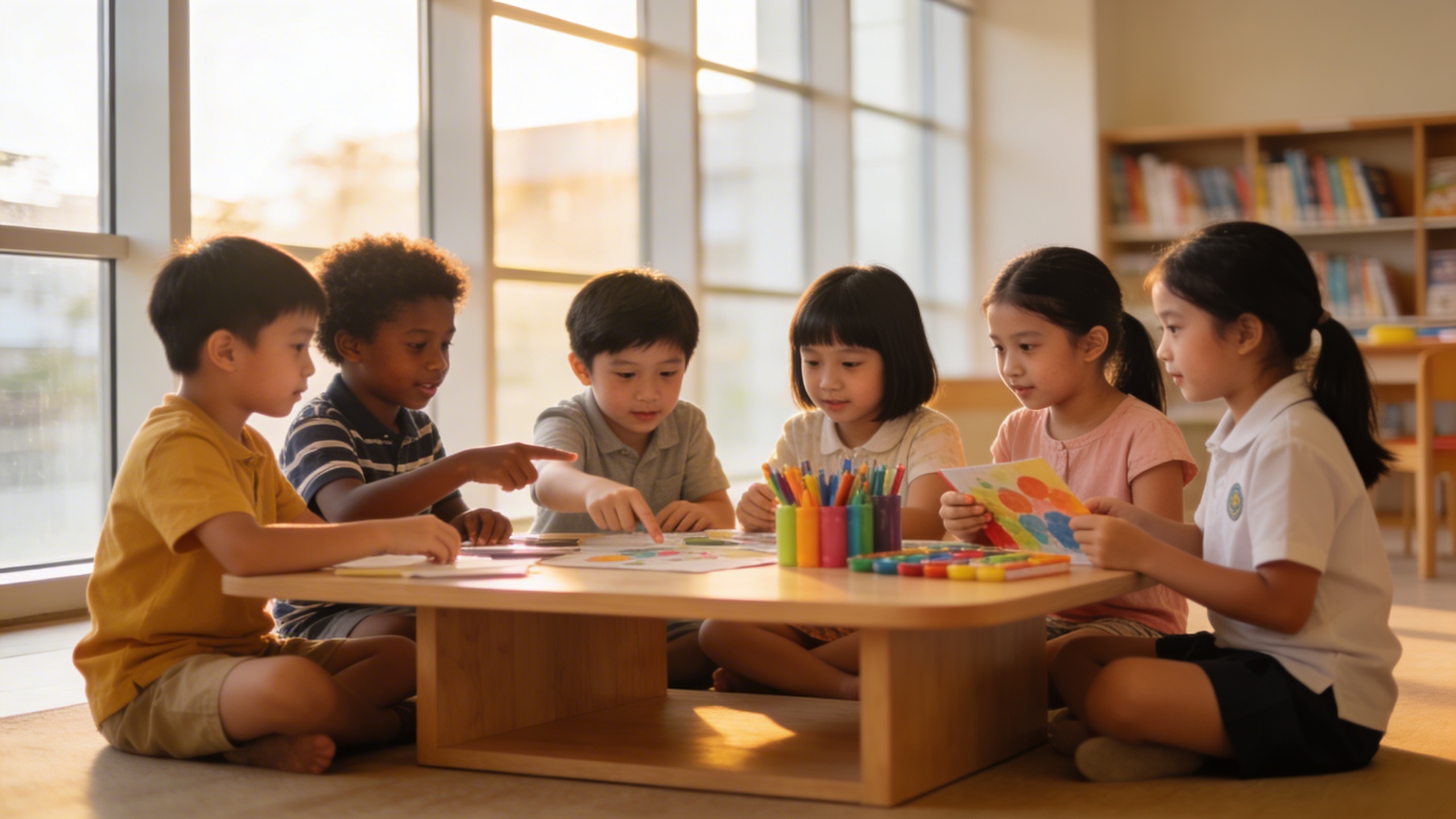
The international school my children attend also has no entrance ceremony like Japan’s. The day Hikari moved up to Year 1 (equivalent to 1st grade), and the day Zen progressed from Foundation Stage (kindergarten) to Primary, were simply “the Monday school started.” Their classroom seats changed slightly, a few new classmates joined, and the teacher gave a brief explanation of “what we’ll learn this year.” That was it.
This “de-ritualization” holds deep meaning. Education is positioned not as a special “event,” but as an everyday “process.” The Japanese entrance ceremony is a rite of passage for the child, and also for the parents. It’s a space where external validation is given, acknowledging “my child has become a member of society.”
However, in the international school environment, that validation is embedded within the daily accumulation of learning. The child’s own realization of “I can do this better than yesterday,” or the outcome of a project, becomes the proof of achievement, replacing the ceremony. For entrepreneurs who value results and personal growth, this is a relatable philosophy, isn’t it?
The Shift from “Demarcation” to “Continuity”
Japanese education has clear “demarcations”: kindergarten, elementary school, junior high, high school. Each stage has goals, and advancement to the next stage is based on achieving them. In a way, this is easy to manage and has clear objectives.
On the other hand, international curricula like the IB (International Baccalaureate) emphasize “continuity.” For instance, there was news about the proven academic superiority of the IB’s MYP (Middle Years Programme) in the latest IBO research. The strength of the MYP lies not just in subject knowledge, but in consistently nurturing “methods of inquiry” and “ways of thinking.” The inquiry skills developed in the Primary Years Programme (PYP) deepen in the MYP and are perfected in the Diploma Programme (DP). This is akin to the business philosophy of talent development based on a medium-term management plan.
From the core philosophy of this media, which views education migration as a “family lineage strategy,” this “continuity” is extremely important. It involves designing a child’s education as a long-term investment plan spanning 12 years or more. In this context, unnecessary “demarcations” or “resets” can potentially lower investment efficiency. This is also why many international schools in Malaysia offer a consistent curriculum from kindergarten through high school.
The “Blank Space” as an Environment for Nurturing the “Nail That Sticks Out”
The Japanese entrance ceremony strongly emphasizes belonging to a group. The same uniforms, lining up, synchronized actions. While this fosters social skills, it is also the starting point of a culture where “the nail that sticks out gets hammered down.”
What I feel in Malaysia’s multicultural environment is that there is no such thing as a “homogeneous nail” to begin with. In Hikari and Zen’s classes, there is a mix of Malay, Chinese, and Indian children, children of expatriates from the West, and families like ours who migrated for education. Religions, language backgrounds, and values are all diverse. In such an environment, rather than being “the same as everyone else,” children naturally confront questions like “Who am I?” and “How do I think and express myself?”
This environment is the ultimate training ground for children expected to thrive on a global stage in the future. It’s because they can daily cultivate the ability to establish their own identity and collaborate while surrounded by differences. When affluent families seek to maximize their children’s human capital, this ability of “self-establishment amidst diversity” becomes an asset more valuable than language skills.
Redefining “Ritual” in Education Migration
So, how should education migration families celebrate their children’s milestones? We have started creating “family-unit meaning-making” instead of formal ceremonies.
For example, when Hikari finishes a major project, we go to a restaurant as a family and discuss the content of her presentation. When Zen becomes able to read a book he couldn’t before, we celebrate it greatly within the family. We feel that the accumulation of these small “acknowledgments” builds the children’s confidence and becomes intrinsic motivation for learning.
This approach might be easy for entrepreneurs to understand. It’s about measuring an employee’s growth not just by the “ritual” of annual reviews or promotions, but by giving timely evaluation and feedback for “actual achievements” like project completion or skill acquisition. The same principle is effective in education.
Latest Exchange Rate Information and Investment Decisions
When viewing education as a long-term investment, exchange rates cannot be ignored. The latest exchange rate is 1 MYR = 39.61 JPY (as of April 7, 2026). Based on this rate, tuition fees at international schools in Malaysia can still be considered cost-effective compared to some private and international schools in Japan.
However, the important thing is not a single-year cost comparison. What’s required is “household financial planning” to provide a stable, long-term, continuous education as discussed earlier, while accounting for exchange rate fluctuation risks. As entrepreneurs, you can likely apply concepts like forex hedging to your children’s education expense planning.
Re-examining the Essence from What is “Absent”
The fact that there is “no entrance ceremony” gives us a paradoxical insight. It is precisely through the formal “absence” that the “essence of education” is brought into sharp relief.
Considering education migration is not simply about comparing the pros and cons of Japan. Rather, it is an opportunity to return to a fundamental question by encountering diverse educational approaches: “What does our family value most in our child’s growth?”
Valuing the quality and continuity of daily learning over rituals and formality. Supporting the establishment of the individual within diversity over belonging to a homogeneous group. Life in Malaysia has shown our family that such choices exist in reality. What is the essence of education for your family? I believe all strategy begins with that question.
Comments