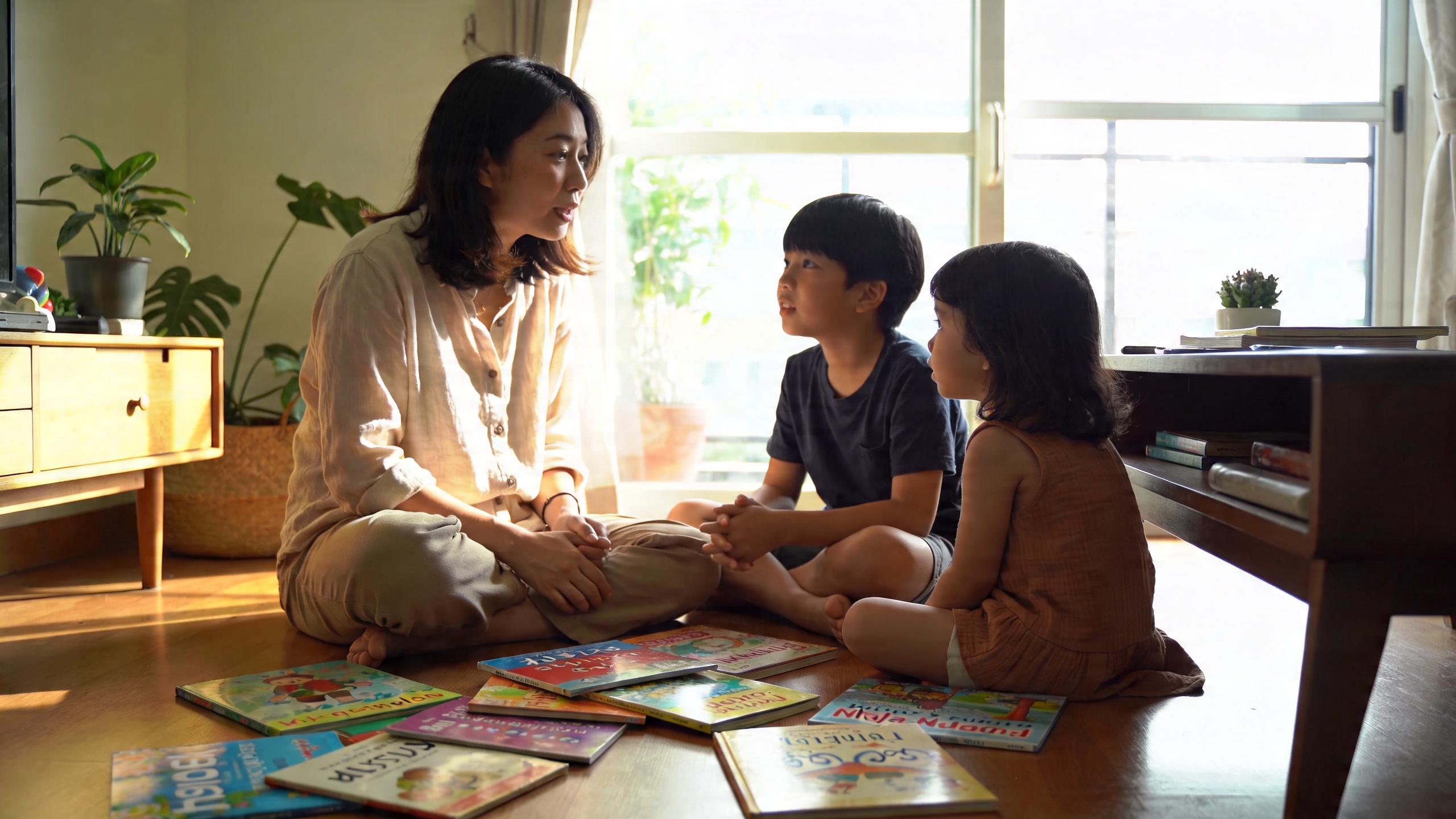
Hello. I’m Saori, living in Penang, Malaysia, with my three children who attend an international school.
When considering education migration, we often tend to be captivated by the benefit of “acquiring English proficiency.” It’s true that my eldest daughter, Hikari (born 2018), and eldest son, Zen (born 2020), have been attending the international school for three and a half years. Now, they increasingly converse in English even between themselves, sometimes speaking at a speed I can’t follow.
However, I recently realized something. It’s the fact that my children’s “linguistic center of gravity” has, without my noticing, decisively shifted from Japanese to English. This change harbors a deeper identity issue beyond the joyful achievement of simply “becoming good at English.” Today, I’d like to talk about this “linguistic identity” risk, which lies on the flip side of education migration’s bright aspects, and our family’s practical countermeasures.
The Weight of the Question: “Mom, what’s this in English?”
The other day, while playing with my youngest daughter, Yukari (born August 2024), my son Zen suddenly asked, “Mom, what’s ‘omutsu’ (diaper) in English?” For a moment, I was at a loss for words. He knows the Japanese word “omutsu.” But in his mind, a circuit that directly connects the “concept” of things with their “English label” is being prioritized for construction. Japanese is, on the contrary, becoming a second language that requires “translation.”
This isn’t just a phenomenon with 5-year-old Zen. When 7-year-old Hikari explains complex emotions or events at school, it’s clear she thinks in English first and then tries to “convert” it into Japanese. Sometimes, the conversion can’t keep up, and she starts in Japanese with “You know, that thing…” and then mixes in English words.
Our goal isn’t just raising “bilingual” children. We aim to raise “bicultural” individuals who have Japanese as their mother tongue, value Japanese culture and roots, and can also wield English freely. However, in an environment where over 80% of daily life is spent in English, maintaining this balance is a more challenging endeavor than one might imagine.
The Tipping Point Where the “Mother Tongue” Swaps
In language acquisition research, it’s said that beyond a certain age, the primary language of use establishes itself as the “mother tongue.” The point where thinking, emotions, and even dreams occur in that language is particularly important. In the case of Hikari and Zen, much of their school learning, play with friends, reading, and, above all, the act of “thinking” itself has begun to happen in English.
This change is a great strength academically. In programs like the IB (International Baccalaureate), advanced critical thinking and essay writing are required. Having the language of thought align with the language of learning is undoubtedly advantageous.
However, the potential cost is the risk of relatively weaker abstract thinking in Japanese and complex emotional expression. Deep conversations with grandparents, appreciating Japanese literary works, and even the advanced Japanese negotiation skills needed for future business… These are insufficient with just conversational-level Japanese proficiency.
According to the latest exchange rate information (as of April 19, 2026), 1 Malaysian Ringgit = 40.20 Yen. Education migration involves not only visible costs like tuition and living expenses but also the invisible cost of maintaining this kind of “cultural and linguistic capital.”
Our Family’s “Japanese Defense Line” in Practice
To address this challenge, our family engages in conscious “design of the Japanese language environment.” This is a systematic effort that goes beyond simply speaking Japanese at home.
First is the “strict enforcement of the family’s common language.” Conversations between spouses and between parents and children are, in principle, Japanese only. Even if the children reply in English, I respond in Japanese. This is to instill in them that Japanese is “the language of the safe zone that is home.”
Second is “ensuring intellectual stimulation in Japanese.” Twice a week, they take online Japanese language lessons (not following textbooks, but specialized in story comprehension and composition). We also regularly order Japanese children’s books and reference books, intentionally creating experiences of “learning” and “knowing” in Japanese. This costs about 20,000 to 30,000 yen per month (approximately 500-750 Ringgit), but if we view Japanese proficiency as an investment, it’s an essential expense.
Third is “creating emotional touchpoints with Japan.” Of course, we have regular video calls with grandparents, and we recreate Japanese seasonal events (Setsubun, Hinamatsuri, Tanabata) at home. Furthermore, we always return to Japan during long vacations, valuing time spent in nature. The goal here is to position Japanese not as a “nostalgic language of a homeland” but as a “living language that is part of who I am now.”
A New Definition of Education Migration Success: “Linguistic Hybridization”
Traditionally, the success of education migration tended to be measured by “admission records to prestigious universities” or “fluent English skills.” However, I believe that alone is insufficient. True success depends on whether one can establish their own “core” amidst multiple languages and cultures.
Hikari said something the other day: “Mom, I am both a Japanese kid and an international school kid. It’s not one or the other; it’s both.” This is a manifestation of her own identity exploration. Our role as parents is to prepare the groundwork so she can establish this state of “being both” as a strength, not a complex.
To do this, a shift in mindset is necessary: from a passive stance of “protecting” Japanese to an active stance of “combining and elevating” Japanese and English. For example, having them give a presentation in English about Japanese history, or explain a scientific concept learned at school in Japanese. This kind of “back-and-forth movement” guides language to a dimension where it enriches thinking itself, not just serving as a tool.
Specific Advice for Families in the Consideration Stage
If you are considering education migration, please incorporate a “family language strategy” into your plans alongside school curriculum and tuition fees.
1. Preparation Before Moving: While still in Japan, read Japanese picture books aloud abundantly. Imprinting rich vocabulary and the rhythm of Japanese into their bodies will serve as a breakwater later on.
2. Securing Local Resources: Many excellent Japanese language teachers reside in Malaysia. After moving, start researching tutors or Japanese language classes immediately. Depending on the community, there may be opportunities to make friends who speak Japanese.
3. Setting Realistic Goals: Maintaining a child’s Japanese proficiency at the native level of their same-grade peers in Japan is extremely difficult. Reset your goals to something realistic and meaningful, like “maintaining conversational ability” to “a level where they can have deep discussions in areas of interest.”
Education migration is a wonderful option for expanding a child’s potential. However, please keep in mind that in exchange for “gaining” something, it also involves constant effort to “maintain” something else. Language and identity form the very foundation of a child’s growth. I hope you can walk this path without losing sight of that balance, discussing it together as a family.
Our family is also still in the trial-and-error stage. I would be happy to share this complex and rich journey with families who share the same aspirations.


Comments