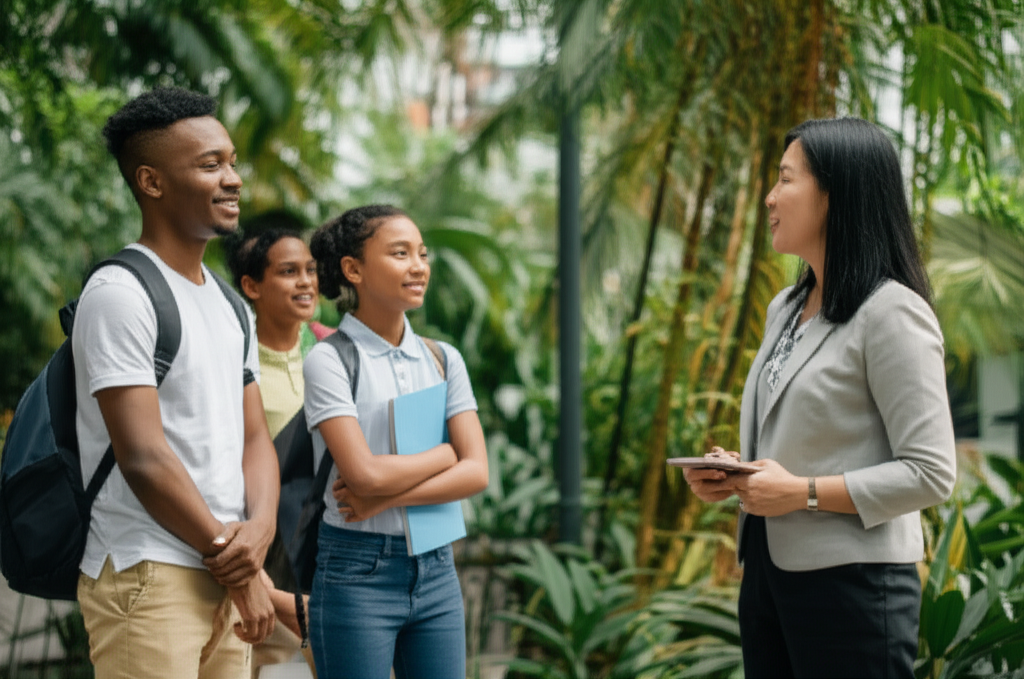
For education migration to succeed, it’s essential to design your entire life as a stable, functioning system—not just school selection, but also healthcare, daily routines, extracurricular activities, and home language use. This article details practical life planning and optimization strategies to reliably advance your education migration to Malaysia (Penang/KL) as a long-term project.
- Conclusion: The Value of Malaysian Healthcare Lies in “Doctor’s Time” and “Decision Finality”
- How to Reduce Daily Life Stress (Shopping, Japanese Food, Transportation)
- Fundamental Premise: Daily Life is a “Cost to be Reduced”
- ① Reduce Shopping Stress: “Fix” Your Options
- Basic Policy: Don’t Think Every Time
- Practical Solution
- ② Reduce Japanese Food Stress: Hold it as “Insurance,” Not a Dependency
- Japanese Food is a “Mental Stabilizer,” Not a “Staple Diet”
- Malaysia’s Realistic Strengths
- Practical Usage
- ③ Reduce Transportation Stress: Design to Minimize Trips
- It’s “Number of Trips,” Not “Distance,” That Matters
- Practical Design
- ④ Build Weather & Language Stress into Your Premise
- Practical Response
- ⑤ Reduce “Daily Stress” for Children
- Specific Measures
- ⑥ “Endure Until You Get Used to It” is a Design Flaw
- Summary: Daily Life is an “Optimization Target”
- Extracurricular Activity Design (Music, Sports, Art, CCA)
- ―― Maximize the Sustainability of Education Migration by “Incorporating into Home Life” Rather Than “Sending Out”
- Fundamental Premise: Activities are Devices for Creating “Stability,” Not “Achievement”
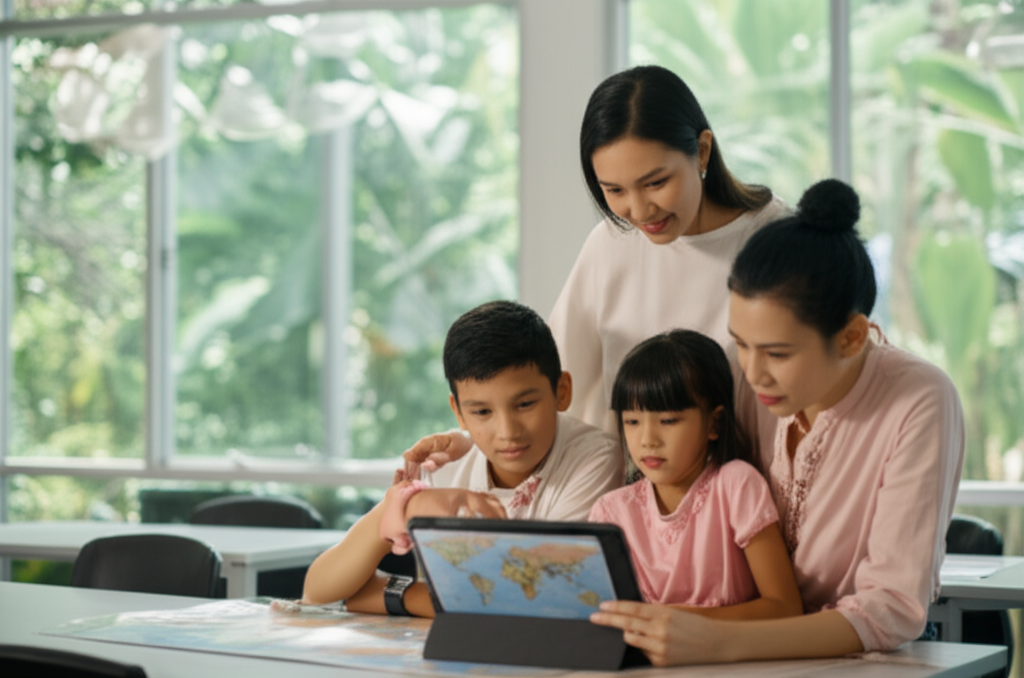
- The “Teacher Comes to Your Home” Model is Viable
- Why It Works
- Environmental Reality: Lesson Space is Already Available
- For Condominiums
- For Detached Houses
- Especially Important: One-on-One May Be the Optimal Solution Depending on Age/Phase
- Typical Cases Where One-on-One is Suitable
- The Essential Value of Home One-on-One
- Essential Value of Home One-on-One
- By Field: Compatibility with Home Lessons (Detailed Overview)
- Music (Best Compatibility)
- Dance & Physical Expression
- Art
- “Transitioning” to Group Lessons/CCA Can Come Later
- Transition Indicators
- Combination with CCA (Reorganized)
- Essence: Design Activities to “Lighten Life”
- Home Language Use (Mother Tongue × English × Third Language)
- ―― “Home Language Design” Reverse-Engineered from the Abilities Sought by World Top Universities
- Abilities World Top Schools Truly Value
- Abstract Thinking Ability
- Structuring Ability
- Deep Self-Awareness and Verbalization
- Ability to Use Language as a Tool
- Decisive Fact: This Ability Cannot Be Cultivated by English Alone
- The Role of Mother Tongue (Japanese): The Language that Builds the Thinking Engine
- Why Mother Tongue Should Be Secured at Home
- Practical Mother Tongue Usage Guidelines
- The Role of English: The Language that Connects Thought to the World
- Social English
- Academic English
- Minimal Yet Essential Design Possible at Home
- Positioning of Third Language: An Extension Option, Not an Evaluation Target
- Why You Shouldn’t Rush
- Correct Handling of Third Language
- Direct Connection Between Home Language Use and University Admissions Abilities
- Common Misconceptions (Practically Dangerous)
- Conclusion: The Home is the “Only Place to Train Thinking”
Conclusion: The Value of Malaysian Healthcare Lies in “Doctor’s Time” and “Decision Finality”
Healthcare in Malaysia (Penang/KL) is advanced in its approach, with many Chinese-speaking doctors familiar with Kanji culture and many physicians having studied in the West. There is significant investment in facilities catering to affluent demographics, and specialization in pediatrics is well-developed. Doctors often provide long, attentive consultations. This combination creates a “medical infrastructure where decisions are not delayed.” Education migration is a long-term endeavor, and an environment where healthcare doesn’t falter maintains family productivity and ultimately forms the foundation for boosting educational outcomes.
To run your education migration project stably, decide on one nearby private general hospital after securing housing, checking for night/weekend (emergency) services and access to pediatric specialists. Also, confirm the cashless conditions of your insurance (overseas/local) and organize and bring your Japanese maternal and child health handbook, medical history, and vaccination records. This significantly reduces medical uncertainty.
How to Reduce Daily Life Stress (Shopping, Japanese Food, Transportation)
―― Practical design to turn education migration from a “life struggle” into “stable operations.”
Whether education migration succeeds in the medium to long term depends less on the school or curriculum and more on how much daily life runs “without conscious effort.” Shopping being a hassle, struggling with meals, getting tired from moving around—these are small problems individually, but when they accumulate daily, they steadily erode parental decision-making capacity and family reserves. This section organizes practical approaches to structurally reduce daily life stress in Malaysia (Penang/KL).
Fundamental Premise: Daily Life is a “Cost to be Reduced”
In education migration, attention tends to focus on English schools and advancement strategies, but the biggest bottleneck in the execution phase is the time and decision fatigue consumed by life operations. The key is not perfect living, but how quickly you can create a life that “runs without thinking.”
① Reduce Shopping Stress: “Fix” Your Options
Basic Policy: Don’t Think Every Time
The most tiring part of shopping is deciding each time where to go, what’s available, and if the price is reasonable.
Practical Solution
Fix on 1-2 large shopping malls and decide that daily necessities and groceries are bought “here.” Actively utilize online delivery (food, daily goods). In Malaysia, malls almost completely cover food, daily goods, medicine, and children’s items. Simply fixing your destination drastically reduces decision-making.
② Reduce Japanese Food Stress: Hold it as “Insurance,” Not a Dependency
Japanese Food is a “Mental Stabilizer,” Not a “Staple Diet”
In education migration, it’s rational to position Japanese food not as something eaten daily, but as a base to return to when tired.
Malaysia’s Realistic Strengths
There are multiple Japanese grocery stores and supermarkets, with stable supplies of soy sauce, miso, rice, and frozen foods. Restaurant quality is also above a certain standard. Consequently, the fear of “not being able to eat” hardly arises. However, constantly searching for Japanese food and comparing it to Japanese standards conversely creates stress.
Practical Usage
- Keep soy sauce, miso, dashi, and Japanese rice stocked at home.
- Base dining out on Chinese, Western, Korean, etc., cuisine.
- Use Japanese food for recovery when fatigued or unwell.
This significantly lowers the mental cost related to food.
③ Reduce Transportation Stress: Design to Minimize Trips
It’s “Number of Trips,” Not “Distance,” That Matters
Transportation fatigue is determined more by how many trips you make in a day than by how many kilometers you travel.
Practical Design
- Choose housing in an area close to school, hospital, and mall.
- Avoid “while I’m at it” errands; consolidate tasks.
- Minimize parental driving by utilizing drivers and delivery services.
④ Build Weather & Language Stress into Your Premise
In Malaysia, heat, downpours, and traffic jams are unavoidable. The key is to treat them not as “exceptions” but as premises.
Practical Response
- Aim for a mall-centric life with many indoor pathways.
- Secure transportation routes that are viable even in rain.
- Regularly use ride-hailing apps like Grab.
For language, incorporate into your living area places that function even without perfect English, or shops with many visual aids and standard procedures.
⑤ Reduce “Daily Stress” for Children
What’s important for children is an environment where parents aren’t irritable and the home is stable.
Specific Measures
Fix after-school hangout spots and create favorite shops/parks. Keeping travel time short makes life outside school a “comfort zone.” In education migration, the presence of this comfort zone determines staying power.
⑥ “Endure Until You Get Used to It” is a Design Flaw
A common failure is the mindset of “it’s tough at first, but you’ll get used to it.” In reality, many cases involve burnout before getting used to it, leading to diminished judgment and increased family friction. First, create a design that runs without struggle. This is the premise for making education migration viable as a long-term endeavor.
Summary: Daily Life is an “Optimization Target”
In education migration, shopping, meals, and transportation are not trivial issues. How much you can automate and standardize these directly impacts the ROI of your educational investment. Decide where to go, have food insurance, reduce trips, eliminate exceptions. No flashy tricks are needed. Families that create a daily life that runs without thinking are the ones who see the long-term project of education migration through to the end. That is the essence of reducing daily life stress.
Extracurricular Activity Design (Music, Sports, Art, CCA)
―― Maximize the Sustainability of Education Migration by “Incorporating into Home Life” Rather Than “Sending Out”
Extracurricular activities in education migration are not merely skill acquisition or leisure. They are life design itself—how to design a child’s energy allocation, daily routes, and self-esteem. Especially overseas, transportation costs, language stress, and fatigue from environmental changes are greater than in Japan, so activity planning based on the premise of “sending them out” must start from the understanding that it can suddenly make life much heavier.
Fundamental Premise: Activities are Devices for Creating “Stability,” Not “Achievement”
During the education migration period, especially the initial to pre-stabilization phase, you should not chase competitions, levels, or achievements. The priority is clear: ensure school life isn’t disrupted and secure time for the child to immerse themselves with peace of mind. From this perspective, the option of home lessons is extremely rational.
The “Teacher Comes to Your Home” Model is Viable
In Malaysia (Penang/KL), the style where teachers come to your home or residence to teach is not unusual.
Why It Works
- Teachers are accustomed to home visits.
- Condominium shared facilities are well-equipped.
- “Designs to reduce travel” for affluent demographics are common.
This is a much bigger difference than you might imagine from a Japanese perspective.
Environmental Reality: Lesson Space is Already Available
For Condominiums
Condominiums catering to education migration very often have dance rooms, multi-purpose rooms, studios, and yoga/fitness spaces. Using these, lessons in physical expression like dance, gymnastics, ballet basics, and rhythm training can be completed within the premises. Zero travel, zero weather impact, and zero parental judgment about pick-up/drop-off are overwhelming advantages in education migration.
For Detached Houses
In detached houses for education migration, it’s not rare to have a dance room or soundproofed/multi-purpose space within the home. In this case, it’s possible to design the house itself as a “place of learning.”
Especially Important: One-on-One May Be the Optimal Solution Depending on Age/Phase
A point Japanese families often overlook is that there are definitely periods where “group settings are not optimal right now.”
Typical Cases Where One-on-One is Suitable
- Preschool to lower elementary grades.
- Immediately after moving, fatigued by environmental change.
- Early English stage where group instructions are burdensome.
- Introverted or sensitive personality.
- Shrinks from others seeing them “unable to do something.”
Forcing group lessons during this period can lead to disliking the activity itself, loss of confidence, and negative impacts on school adaptation.
The Essential Value of Home One-on-One
Essential Value of Home One-on-One
Lessons at home have value beyond skill acquisition in ensuring psychological safety. Accumulating feelings of “I can do it” and “this is fun” in a familiar space without the eyes and comparisons of others determines medium-to-long-term growth.
By Field: Compatibility with Home Lessons (Detailed Overview)
Music (Best Compatibility)
Piano, violin, cello, and vocals are fields where home one-on-one lessons are highly effective. They allow for concentration even in short sessions, enable immediate practice→instruction→correction, and are less affected by environmental changes. Music is extremely powerful in education migration as an “unchanging axis even when the environment changes.”
Dance & Physical Expression
Dance, gymnastics, and ballet basics are sufficiently viable in condominium dance rooms or home multi-purpose spaces. Even without a group, basics, posture, and body usage can sometimes be of higher quality in a one-on-one setting.
Art
Painting, modeling, and crafts are fields with very good compatibility with home one-on-one lessons. Especially for children with high sensitivity who find it hard to express emotions verbally, home art becomes a device for emotional processing and building self-esteem.
“Transitioning” to Group Lessons/CCA Can Come Later
The important recognition is that home one-on-one is not an “escape” but a preparation phase.
Transition Indicators
- School life is stable.
- Can understand English instructions.
- Friendship circles have expanded.
At this stage, transitioning to school CCAs, team sports, group dance, etc., is fine. At that point, a division of roles is established: utilizing the foundation built externally (at home) in a setting at school.
Combination with CCA (Reorganized)
- CCA: A place for beginners, to try things, a place to belong within school.
- Home/External: A place to seriously hone skills.
Being able to demonstrate a skill honed at home as “relatively strong” in school CCA directly connects to confidence, position within school, and a sense of security in the English environment.
Essence: Design Activities to “Lighten Life”
The essence of extracurricular design in education migration is not how much progress is made, but how well life continues without breaking down. Reduce travel, reduce comparisons, reduce decisions. One optimal solution is one-on-one lessons at home. Families that can combine home, external, and school CCA based on this premise, according to age, personality, and migration phase, are the ones who can run the long-term project of education migration smoothly and reliably. That is the practical optimal solution in activity design.
Home Language Use (Mother Tongue × English × Third Language)
―― “Home Language Design” Reverse-Engineered from the Abilities Sought by World Top Universities
Many families considering education migration tend to assume that “English will improve if you’re in an English environment” and “the earlier you start multiple languages, the better.” However, in admissions to world top schools like Harvard and MIT, English proficiency and GPA are no longer differentiating factors. What they ultimately look for is: Can you think abstractly? Can you structure your thoughts? Can you verbalize your interests and concerns? Are you using language not as an “ornament” but as a “tool for thought”? These abilities are decisively influenced more by how language has been used at home than by the school’s linguistic environment. This section details how to connect the abilities ultimately tested at the university admissions level with home language use, based on how language is handled at home.
Abilities World Top Schools Truly Value
Applicants to Harvard and MIT almost invariably have high English proficiency, high GPAs, and excellent standardized test scores. What distinguishes acceptance from rejection among them are the following abilities:
Abstract Thinking Ability
- Can generalize from specific events.
- Can verbalize underlying structures and premises.
- Can explain “why it is so,” not just superficial conclusions.
Structuring Ability
- Can organize information and present it in logical order.
- Can naturally construct argument, evidence, counterargument, rebuttal.
- Can decompose complex problems into manageable forms.
Deep Self-Awareness and Verbalization
- Can articulate in their own words—not borrowed expressions—why they became interested, what felt off, what they learned from failure.
Ability to Use Language as a Tool
- Not fluency or vocabulary size, but the ability to accurately convey thoughts to others.
In other words, top school admissions are not language proficiency tests but selections for thinking ability.
Decisive Fact: This Ability Cannot Be Cultivated by English Alone
This is the point Japanese families most often misunderstand. Abstract thinking and structuring abilities do not necessarily need to be developed first in English. In fact, in many cases, children who can think deeply in their mother tongue often show faster growth when switching to English. The reason is simple: depth of thought can only be trained in the language you can use with the least cognitive load.
The Role of Mother Tongue (Japanese): The Language that Builds the Thinking Engine
The mother tongue at home is not merely a communication tool. It is the foundation (OS) of thought, responsible for understanding abstract concepts, grasping cause and effect, organizing emotions, and forming values.
Why Mother Tongue Should Be Secured at Home
Especially during periods of significant environmental change, like the initial migration phase for preschool/elementary children, weakening the mother tongue can easily lead to shallow thinking, inability to verbalize emotions causing instability, and English also remaining superficial.
Practical Mother Tongue Usage Guidelines
- Basic home language is Japanese.
- Scolding, encouraging, conveying values: do it in Japanese.
- Deep discussions and reflections are always done in the mother tongue.
This is not an obstacle to English acquisition; it’s building the foundation upon which English can be mounted.
The Role of English: The Language that Connects Thought to the World
In education migration, English should not be treated as a monolith but understood in a two-layer structure.
Social English
Conversations with friends, play, daily instructions naturally increase through school, CCA, and activities. There’s no need to force it at home.
Academic English
Reading comprehension, logical writing, essays, exam/research expression will not improve if left alone.
Minimal Yet Essential Design Possible at Home
Understand content in Japanese, organize cause and effect in Japanese, then summarize it briefly in English. This process is not English education; it’s training in thought structuring + language conversion. Children who undergo this training become not just people who can speak English, but people who can handle thoughts in English. Harvard and MIT want the latter.
Positioning of Third Language: An Extension Option, Not an Evaluation Target
In the Malaysian environment, there are abundant opportunities for contact with third languages like Chinese or Malay. However, the crucial judgment is not to rush the third language.
Why You Shouldn’t Rush
Introducing a third language seriously while the mother tongue is incomplete and English hasn’t reached an academic level increases the risk of scattered thinking and everything becoming half-baked.
Correct Handling of Third Language
- Daily contact, play, CCA: no problem.
- Forced learning at home: postpone.
- Serious introduction: after English is stable (rough guide: 1.5–3 years after moving).
In top school admissions, the mere number of third languages almost never determines acceptance or rejection.
Direct Connection Between Home Language Use and University Admissions Abilities
The daily use of language at home is directly building the university admissions abilities of 10 years later.
Common Misconceptions (Practically Dangerous)
- Making the home English too brings you closer to top schools.
- The mother tongue will be maintained naturally.
- Early multilingualism is advantageous.
- Native pronunciation is valued.
In reality, top schools value a non-native who can think deeply over a native with shallow thinking.
Conclusion: The Home is the “Only Place to Train Thinking”
School is the place to immerse in English. Meanwhile, home is the place to organize thoughts, recover emotionally, and practice abstraction and structuring. Complete thinking in the mother tongue, connect to the world in English, and expand into third languages with spare capacity. Only families that can intentionally design this sequence can elevate education migration from mere English education to an educational strategy that reaches the world’s top tier. Home language use is the most invisible, yet most important, infrastructure in education migration.
Comments