Well-Being Life - Education Migration / Blog
Family Strategy Starting with My 1.5-Year-Old Second Daughter
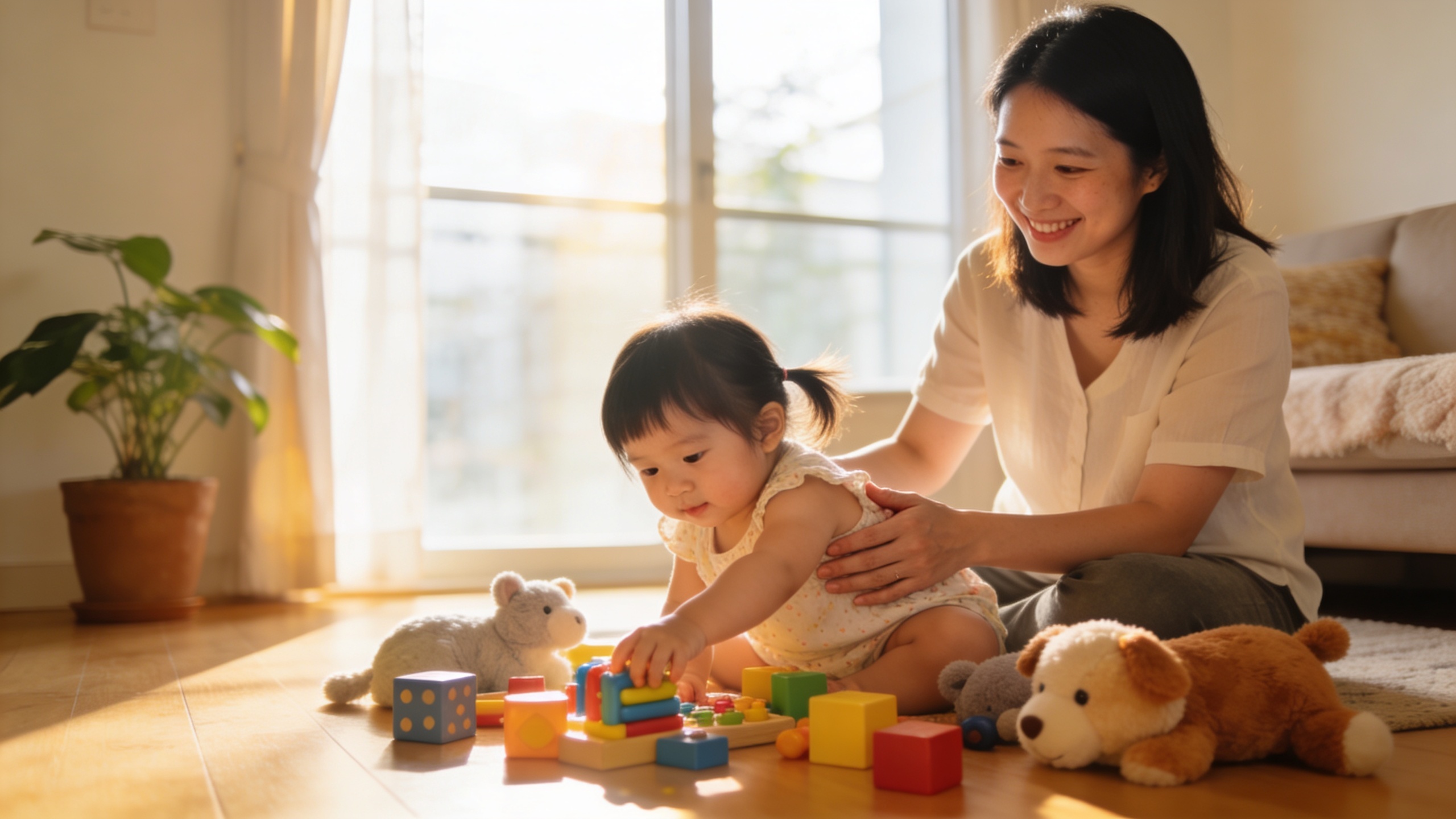
What My 1.5-Year-Old Second Daughter Taught Me
Hello, I'm Saori. It's been three and a half years since we moved to Penang, Malaysia.
The other day, my second daughter Yukari celebrated her 1.5-year-old birthday. She's just started walking, and her vocabulary is limited to "Mama" and "Papa." But watching her grow makes me think about the "true starting line" of education migration.
My eldest daughter Hikari (7) and eldest son Zen (5) already spend their days at an international school. Yukari, on the other hand, doesn't attend daycare or preschool yet. She spends most of her time at home with me.
Rethinking the "Right Time" to Start Education Migration
People often say, "The earlier you start education migration, the better." It's true that the critical period for language acquisition is said to be between ages 3 and 12, so bringing Hikari and Zen here wasn't a bad timing.
But watching Yukari, I realize that true "early education migration" isn't just about enrolling your child in an international school as soon as possible.
The Process of Moving "as a Whole Family"
Yukari was born in August 2024, about a year after we arrived in Malaysia. For her, Japan is her "parents' hometown," not her own.
The everyday sounds are a mix of English, Malay, and Chinese. The smell of the air, the food—everything is Malaysian standard. For her, "normal" is already an international environment.
This is an experience Hikari and Zen could never have had. The older two grew up with "Japanese normal" at daycare and preschool in Japan before coming to Malaysia. So, the first six months were a significant culture shock for them.
Education Migration from Age 0 as a Family Strategy
What I've come to realize through Yukari is that education migration is less about "educating your child" and more about "a family strategy."
Overseas Chinese choose cities for education. Jewish people choose countries for education. For them, their children's education is an "investment in the family's future," not just "finding a school."
Yukari Needs an "Environment," Not "Education"
There's no need to "teach" Yukari anything at 1.5 years old. Rather, I feel our role as parents is to create an environment where she can absorb things naturally.
Specifically, I focus on these three things:
First, the language environment at home. She speaks Japanese with me and her father, but outside, English is everywhere. This "normal" is naturally building bilingual circuits in her brain.
Second, exposure to diversity. In Penang, Chinese, Malay, and Indian people coexist naturally. Before Yukari can recognize differences in skin color or religion as "unusual," she accepts them as "normal."
Third, our parental network. The relationships I've built with Japanese mom friends and local business partners in Penang will become Yukari's future "social capital."
Reassessing the "Exit Strategy" Starting at 1.5 Years Old
I previously wrote about "setting an exit strategy for education migration," but having Yukari has changed how I think about it.
For Hikari and Zen, I considered the exit strategy based on whether they could return to a Japanese school. But Yukari has never experienced Japanese school life. Her "normal" is Malaysian standard.
Continuation, Not Withdrawal, Becomes the Premise
This fundamentally changes the risk calculation for education migration. With just the older kids, there was an escape route: "If worst comes to worst, we can go back to Japan." But if the younger child grows up in Malaysia, returning to Japan isn't a "withdrawal"—it's a "new migration."
In other words, the family's overall commitment becomes stronger.
In fact, since Yukari was born, my husband and I have had more concrete discussions about "buying a house in Penang" or "getting permanent residency in Malaysia." When it was just the older kids, we had a "let's try it for three years" mindset.
The Value of "Now" from the Latest Exchange Rate
As of April 30, 2026, 1 MYR = 40.37 JPY. When I moved here three and a half years ago, it was around 1 MYR = 26 JPY, so the yen has weakened significantly.
This exchange rate greatly impacts decisions about education migration. For example, the average annual tuition at an international school in Malaysia is 80,000 to 150,000 MYR. In Japanese yen, that's 3.23 million to 6.06 million yen (approximately $21,500 to $40,400 USD).
Meanwhile, the average annual tuition at an international school in Tokyo is said to be 2.5 million to 4 million yen (approximately $16,700 to $26,700 USD). Top-tier schools in Malaysia and international schools in Tokyo are now nearly equal in cost.
How the Weak Yen Changes the "Meaning of Education Migration"
Once, the biggest advantage was "Malaysia has cheap tuition." But that's no longer the case. With the yen's depreciation, the simple cost benefit has diminished.
Yet, the reason to choose Malaysia lies in the balance of educational quality and environment. International schools in Tokyo are not only expensive but also highly competitive. In contrast, Malaysian international schools offer a more diverse environment and a relaxed educational style for a similar cost.
What I'm "Investing" in 1.5-Year-Old Yukari
Finally, let me share the specifics of my "investment" in Yukari, including actual numbers.
She won't start international school until at least age 3. Until then, I plan to do everything we can at home.
Specifically, that includes a playgroup twice a week (500 MYR/month, about 20,185 JPY or $135 USD), a parent-child English class once a month (300 MYR/month, about 12,111 JPY or $81 USD), and a weekend swimming class (400 MYR/month, about 16,148 JPY or $108 USD). Total: about 48,444 JPY ($323 USD) per month.
Doing the same in Tokyo would cost at least double. Plus, the playgroup in Malaysia includes not only Japanese children but also local kids and children of expats. I believe this "natural multicultural exchange" offers value that money can't buy.
Why Start "Now," Not "Someday"
I often hear from people considering education migration, "I'll wait until my child is a bit older." But watching Yukari, I believe there's no better time than "now" to start.
At 1.5 years old, she isn't "learning" anything formally yet. But every day, she's learning from her environment: language, culture, relationships, values. These are things that are hard to acquire later, even if you try to "teach" them.
Education migration isn't just for the child. It's about changing the entire family's lifestyle and designing the family's future. And the younger the child, the more flexibility you have in that design.
I can't wait to see how Yukari views the world when she turns 10.