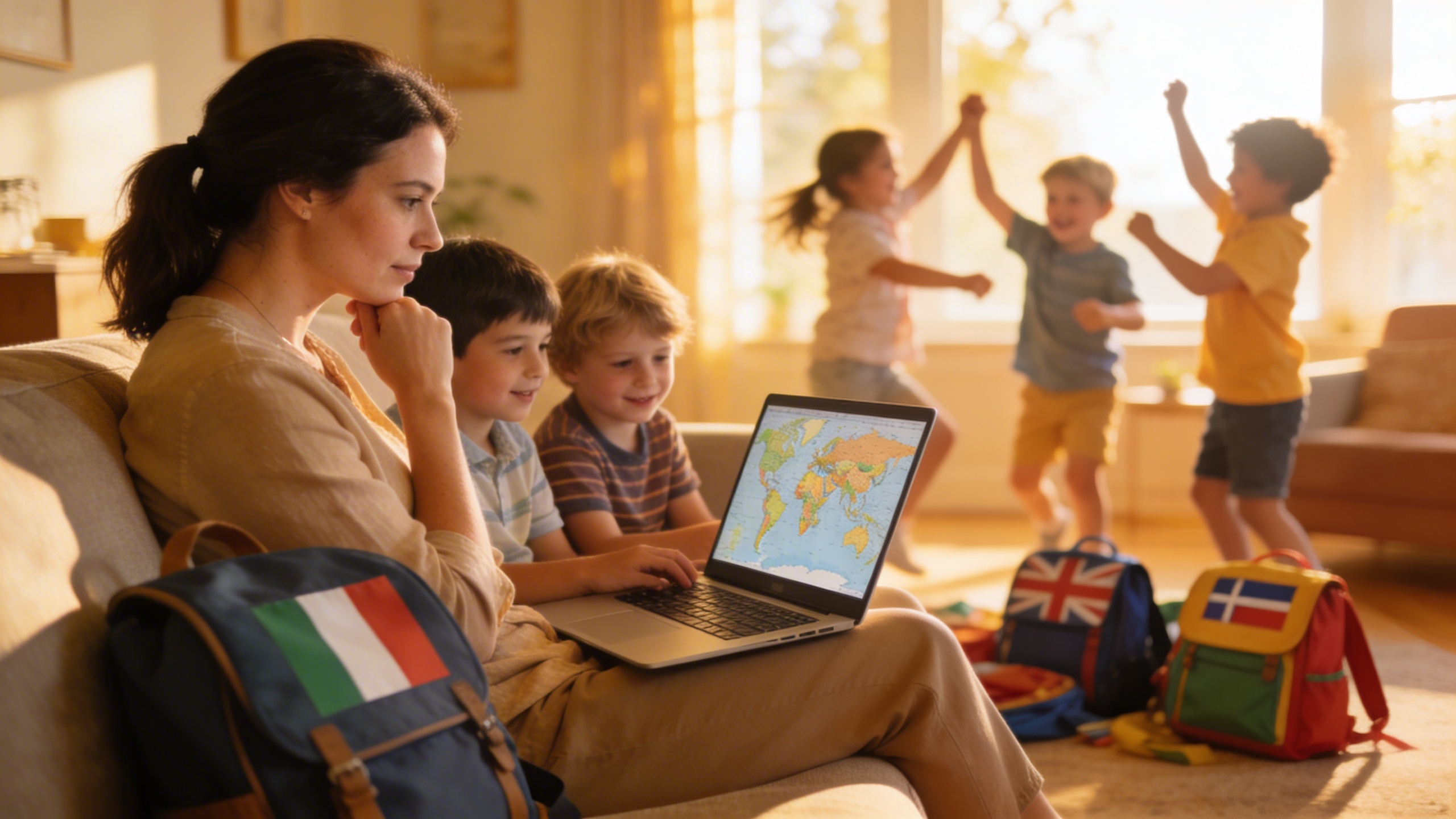
Hello, I’m Saori, raising three children in Penang, Malaysia. My eldest daughter, Hikari, and eldest son, Zen, attend an international school. Recently, I saw articles in Japanese media linking “school refusal” and “overseas relocation.” Toyo Keizai Online cited “school flexibility” and “abundance of choices” as reasons why school refusal is less likely to become severe in Malaysia. It also reported on the realities of families choosing overseas relocation as a “fresh start” from school refusal. These news stories highlight not just an overseas “escape route,” but the structural differences in the educational environment itself. Today, I’d like to reflect from the perspective that this “flexibility” is the essential value provided by education migration.
- The Structural Difference in “Pressure to Keep Attending School”
- The Potential for “Optimization” Created by an Abundance of Choices
- The Conditions Under Which Migration as a “Fresh Start” Functions
- A Real-Life Example of “Flexible Response” Witnessed by Our Family
- The Essence of Education Migration: Flexibility as “Insurance”
- Practical Perspectives for Utilizing “Flexibility”
- An Environment that Fosters “Resilience” for a Child’s Life
The Structural Difference in “Pressure to Keep Attending School”
The Japanese article points out that the “pressure to keep attending school” in Malaysia is completely different from Japan. This is something I strongly feel raising my children here. The Japanese education system places great importance on uniformity and continuity. Once you step off the track, it’s hard to get back on. That “difficulty of return” likely creates enormous pressure for both children and parents. On the other hand, the educational environment in Malaysia, centered on international schools, is premised on diversity from the start. Students’ nationalities, backgrounds, and learning histories are all varied. Transfers and mid-year admissions are commonplace, and schools have systems to accommodate them. Even in Hikari’s class, it’s not unusual for new friends to join mid-semester. This “freedom of movement” fundamentally reduces psychological pressure.
The Potential for “Optimization” Created by an Abundance of Choices
Another major difference is the “abundance of choices.” In Japan, choices tend to be within large frameworks like public, private, or alternative schools. However, in Malaysia, especially in urban areas like KL and Penang, an education “market” exists. The curricula themselves are diverse: British Curriculum, IB, American Curriculum, Australian Curriculum, etc. Furthermore, even within the same curriculum, the atmosphere and teaching philosophy differ greatly from school to school. One school is academically rigorous, another emphasizes arts or sports, and yet another provides strong support for children with special needs. This enables a shift in thinking from the child “conforming to the school” to “choosing a school that fits the child.” If we view school refusal as a “misfit with the current system,” then an environment where one can search for a different, fitting system is itself part of the solution.
The Conditions Under Which Migration as a “Fresh Start” Functions
The news introduces cases where families choose overseas relocation as a “fresh start” from school refusal. Certainly, completely changing the environment can allow a child to reset and take a new step forward. However, the important point here is that mere “geographical movement” is not the solution. What matters is whether the destination environment possesses a “structural flexibility” different from the previous one. Education migration to Malaysia can function as a “fresh start” precisely because this “structural flexibility” is guaranteed. Factors like a low language barrier (English support in many schools), a multicultural environment where being a “foreigner” is not unusual, and transfers being common without scrutiny of the past, all work together.
A Real-Life Example of “Flexible Response” Witnessed by Our Family
Let me share an example of actual school flexibility from our family’s experience. My eldest son, Zen, is a bit shy and takes time to adapt to new environments. When he first enrolled, his homeroom teacher observed him closely. She then suggested, “For the first few weeks, why not start with shortened attendance, just in the mornings? If we force him to stay a full day, he might start disliking school.” This was a flexible judgment tailored to the child, not a uniform manual. Also, at Hikari’s school, they have a “setting” system where, based on learning progress, math and English classes are adjusted across grade levels. Children who excel move ahead, while those needing to solidify basics receive careful support. This attitude of “tailoring to each individual” is woven into the fabric of school life itself. I feel this kind of everyday flexibility creates the soil that transforms the obligatory feeling of “I have to go” into the intrinsic motivation of “I want to go, I want to learn.”
The Essence of Education Migration: Flexibility as “Insurance”
So far, we’ve considered “flexibility” from the angle of school refusal. How does this look when reframed in the broader context of education migration? I believe this “flexibility” is the essential value education migration provides, akin to “educational insurance.” Raising children is like a long voyage. No matter how much you plan, you may encounter unexpected storms along the way (adaptation issues, learning difficulties, friendships, etc.). A uniform system with difficult changes, like Japan’s, is like a single sturdy, large ship. On the other hand, an environment with diverse choices, like Malaysia’s, is like a “fleet” where you can change ships or adjust the course depending on the situation. If one method doesn’t work, another option is right there. This “freedom of choice” and “ease of change” becomes a psychological safety net in the long-term journey of child-rearing.
Practical Perspectives for Utilizing “Flexibility”
That said, to enjoy this flexibility, practical preparation is needed. First, the financial aspect. International school tuition varies, but in Penang, it’s roughly $5,000 to $9,500 USD per year, and can be higher in KL (as of April 11, 2026, 1 MYR = 39.91 JPY). Precisely because there are many choices, parents are required to gather information and make judgments. Also, what ultimately supports a child’s adaptation is family support. Even if the environment changes, it’s meaningless if parental anxiety is transmitted to the child. Relocation is a project for the whole family, and parents themselves having the leeway to accept and enjoy this “flexibility” becomes the greatest strength for the child. In our family too, if there are small stumbles in the children’s school life, my husband and I discuss, “This is the school’s policy, so let’s support this way at home,” and sometimes make fine adjustments while consulting with the school.
An Environment that Fosters “Resilience” for a Child’s Life
Finally, let’s think from a slightly broader perspective. What we wish for our children is surely not just “to enjoy going to school.” We want them to acquire the resilience to live through this era of rapid change nimbly and strongly. The experience of overcoming the difficulty of school refusal through overseas relocation becomes a profound lesson for the child: “There are choices in life,” and “When things aren’t going well, you can change your approach.” Growing up in a multicultural environment like Malaysia means daily exposure to different values and ways of life, which itself is the best material for fostering resilience. The value of education migration cannot be measured solely by a specific curriculum or academic background. Rather, isn’t it about the entire family acquiring the “tools of choice and flexibility” to adjust themselves and their environment and stand up again when facing life’s difficulties?
The relationship between “school refusal” and “relocation” reported in the news seems to pose a fundamental question about education. Where and how to learn? The breadth and freedom of that choice are precisely what keep a child’s potential open and become the key to unlocking the future. In my daily life in Penang, my children continue to teach me this.
Comments