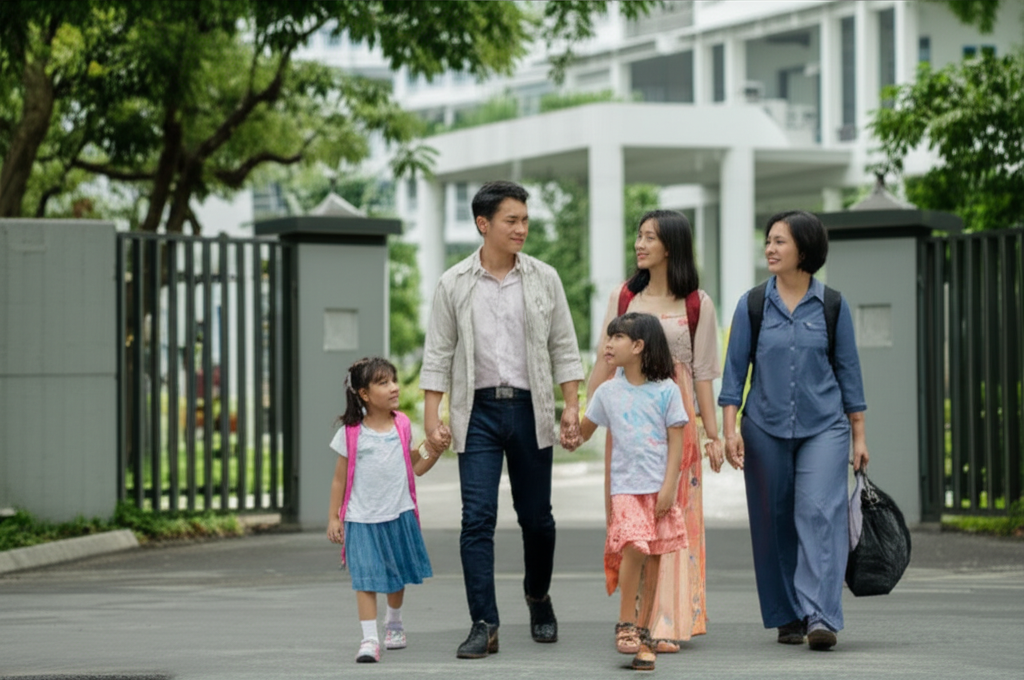
To succeed in education migration, a realistic approach is not to seek a perfect environment from the start, but to upgrade step-by-step through “staircase migration.” Specifically, the route from Penang to KL (Kuala Lumpur), then to Singapore if necessary, and finally to the West, is a rational strategy practiced by the global affluent. It optimizes failure risk and cost while enhancing a child’s adaptability.
- Penang → KL → (If Needed) Singapore → The West.
- Penang: Overwhelmingly Rational as the First Destination.
- KL: The “Mid-Game Battleground” for Seriously Boosting Academic Ability.
- Singapore: The City to Step into as the “Final Stage” Only for Families Who Need It.
- The West: The Final Exit for a Child’s Specialization and Career Formation.
- Why the Staircase Model is the Most Realistic
- Conclusion:
Penang → KL → (If Needed) Singapore → The West.
Many Japanese families considering education migration tend to be bound by the assumption that they must find the perfect solution immediately. However, the educational strategies of the world’s affluent, especially the Chinese diaspora and Jewish communities, operate on the opposite principle: they do not decide on an educational environment in one go. They upgrade their environment in stages, optimizing it over 10-15 years. The most rational way to implement this principle in Southeast Asia is the “staircase migration” model: Penang → KL → (if needed) Singapore → the West.
Penang: Overwhelmingly Rational as the First Destination.
Penang possesses globally rare conditions as an “entry city” for education migration. The reasons are as follows:
- Multicultural × Moderate English Environment: English is dominant but not overwhelmingly native, making it an easier environment for Japanese families to catch up.
- Moderate Difficulty of International Schools: Compared to top-tier schools in KL, the entry difficulty and academic load are appropriate, making it ideal as a first step for children new to English.
- Minimal Lifestyle Burden: Traffic, cost of living, school difficulty, and infrastructure are all low-stress, suitable for the initial adaptation phase of migration.
- Extremely High Cost Efficiency: Living expenses are about 70-80% of KL’s and less than one-third of Singapore’s. This difference significantly impacts long-term educational investment.
Penang can be considered the city with the highest probability of success as a “run-up” to overseas migration.
KL: The “Mid-Game Battleground” for Seriously Boosting Academic Ability.
Moving to KL (Kuala Lumpur) when the child is accustomed to English and the learning style accelerates their growth curve.
- Concentration of Full-Fledged IB/IGCSE Schools: There is a cluster of top-tier international schools in Southeast Asia, such as ISKL, Alice Smith, Garden, and Nexus.
- Multinational and High Academic Standards: The pathway of IGCSE → IB (International Baccalaureate) → overseas universities is clearly established.
- Abundant Urban Educational Infrastructure: Environments for top-tier students are complete, including STEM, arts, sports, debate, and international competitions.
- Living Costs Less Than Half of Singapore’s: The appeal lies in achieving educational value comparable to Singapore’s at a more flexible cost.
Singapore: The City to Step into as the “Final Stage” Only for Families Who Need It.
Singapore offers an excellent educational environment, but not all families need to aim for it from the start. For many reasons, it’s more rational to utilize it as a “final polish.”
- Extremely High Tuition and Living Costs: Annual education costs are 2-3 times those of Malaysia.
- Very High English and Academic Difficulty: The risk of failure increases if non-native English-speaking Japanese families challenge it from the beginning.
- Intense Competitive Environment: It is the strongest city for children who produce results, but entering unprepared risks burning out the child.
Therefore, it should be considered the final stage only for families with a specific “need,” such as aiming for the highest IB scores, wanting to increase academic load in high school, or needing to strengthen applications to Western universities.
The West: The Final Exit for a Child’s Specialization and Career Formation.
The classic route is to use top Western universities as the final exit, built upon the foundation developed in Penang, KL, and (if needed) Singapore. Staircase migration enables this kind of “long-term, cumulative education”:
- Solid academic ability in IB/IGCSE
- Ability to learn and think in English
- Adaptability to multicultural environments
- Experience in international competitions
- Familiarity with recommendation letter culture
- Accumulation of research, volunteer work, and extracurricular activities
Why the Staircase Model is the Most Realistic
Staircase migration is a realistic choice that simultaneously satisfies four major benefits:
- Maximizes the Child’s Adaptation Speed: By not placing them in a maximum-difficulty city immediately, growth in English, academics, and social skills accelerates.
- Minimizes Failure Risk Dramatically reduces the risk of school mismatch, city fatigue, and academic setbacks.
- Optimizes Cost: Enables shaping educational investment into the world-standard form of “low cost in the early stages, maximum investment later.”
- Facilitates Consensus Between Spouses: The flexibility of “starting with Penang” or “changing to KL if it doesn’t suit” fosters positive family discussions.
Conclusion:
“Penang → KL → Singapore → the West” is the “world-standard education migration route” with the highest probability of success for Japanese families. This is neither a luxury nor an adventure; it is the very rational family strategy refined over decades by the Chinese diaspora and Jewish communities. The moment Japanese families adopt this “staircase thinking,” overseas migration transforms from a mere risky event into a strategic process that converges to an optimal point in the long term.

Comments