How the Weak Yen Has Changed Education Migration Cost Calculations
Hello everyone, I’m Saori.
It’s been three and a half years since we moved to Malaysia. Lately, I’ve been hearing from fellow business owners: “The yen is getting weaker—how has that changed the cost of education migration?”
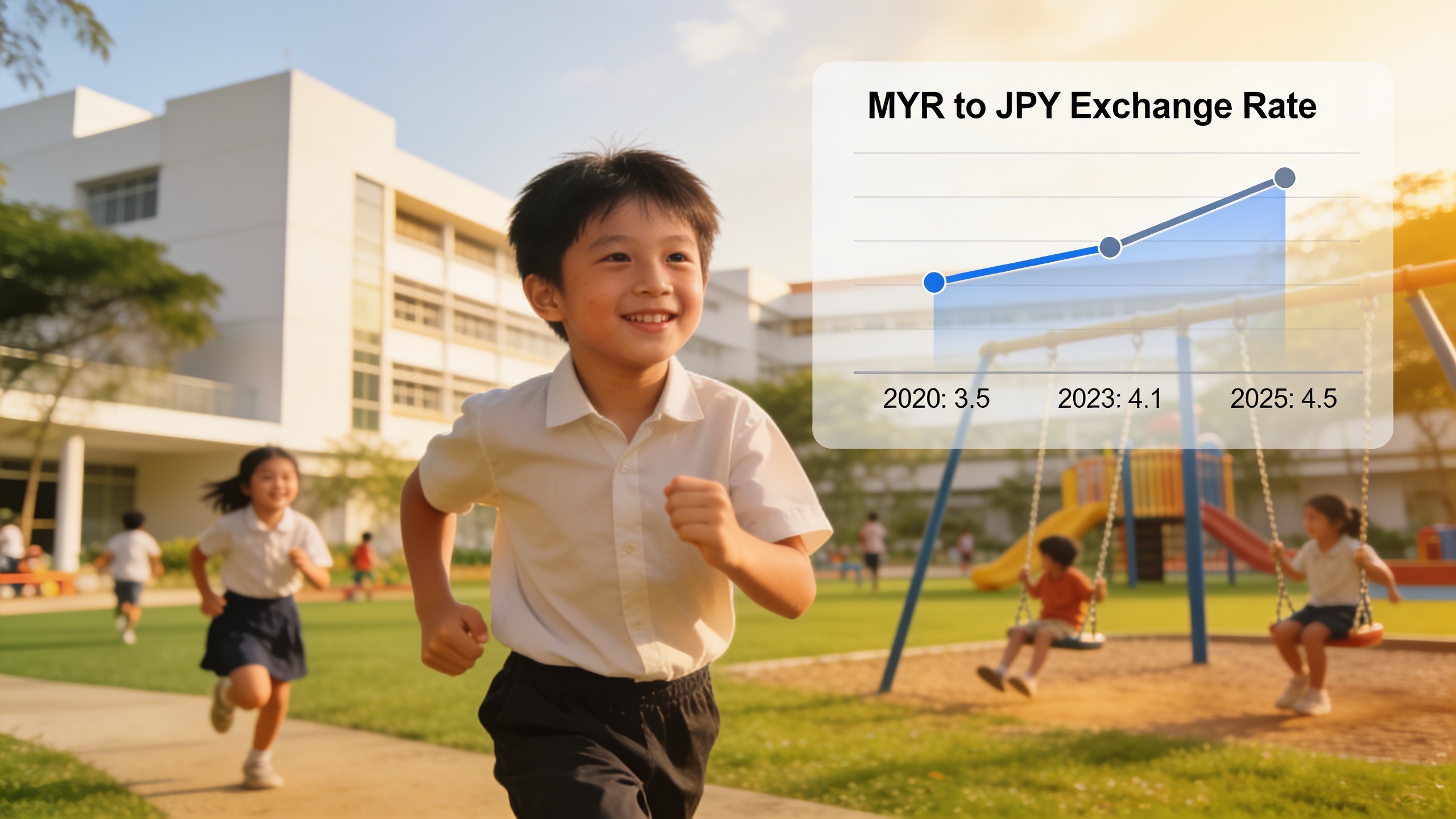
There’s no denying the impact of exchange rates. As of June 22, 2026, 1 Malaysian ringgit equals 39.01 yen. When I decided to move three years ago, it was around 28 yen per ringgit—meaning the yen has weakened by about 40%.
But here’s the key: don’t judge solely by whether the yen is strong or weak. The cost-effectiveness of education migration requires a more holistic view.
The Real Cost of School Fees in Penang and KL
School fees differ significantly between Penang, where I live, and the capital, Kuala Lumpur.
For international schools in Penang, annual fees generally range from 40,000 to 70,000 ringgit. At the current exchange rate, that’s about 1.56 million to 2.73 million yen (roughly $10,500 to $18,300 USD).
Meanwhile, top-tier schools in KL (like ISKL or Alice Smith) charge 80,000 to 120,000 ringgit per year—about 3.12 million to 4.68 million yen (roughly $20,900 to $31,300 USD).
You might think, “That’s so expensive with the weak yen!” But in Tokyo, international school fees typically range from 2 million to 3.5 million yen annually, plus additional costs like enrollment fees and facility charges.
In other words, Penang international schools are less than half the price of Tokyo’s. Even top KL schools are comparable to or slightly cheaper than Tokyo.
Our Family’s Real Expenses
At the international school in Penang where Hikari (2nd grade) and Zen (kindergarten) attend, annual tuition is about 50,000 ringgit (1.95 million yen / ~$13,000 USD). Adding school bus fees and extracurricular activities brings it to around 60,000 ringgit (2.34 million yen / ~$15,700 USD) per year.
For the same level of education in Tokyo, we’d easily pay more than double. Plus, we get added value like an English-speaking environment, multicultural experiences, and a nature-rich lifestyle.
Three Strategies to Manage Exchange Rate Risk
If the weak yen continues, some may feel hesitant about moving. But as any entrepreneur knows, risks can be managed.
Here are three strategies I use.
Hold Assets in Ringgit
If you’re staying in Malaysia long-term, keeping all your money in yen is risky. I have ringgit-denominated deposits in a Malaysian bank, which I use to pay rent and school fees.
This way, I’m not directly affected by exchange rate fluctuations. Buying property is also a strong option.
Pay School Fees Annually in One Go
Many international schools offer annual or semester payment plans. Annual payments are often cheaper than installments and limit exchange rate risk to one transaction.
Our family pays the full year’s fees in March each year. This period often sees the yen stronger, making it easier to time the payment.
Diversify Income Sources Across Currencies
I have two income streams: remote work from Japan and income from my Malaysian company. With earnings in both yen and ringgit, I can offset the impact of exchange rate fluctuations.
For entrepreneurs, consider local business ventures or investments as well.
The True Break-Even Point of Education Migration
Let’s think calmly about the break-even point of education migration.
A simple calculation: the difference between a Tokyo international school (3 million yen annually) and a Penang one (1.95 million yen) is 1.05 million yen. Over three years, that’s 3.15 million yen; over six years, 6.3 million yen.
Living costs are also lower in Malaysia—rent is less than half of Tokyo’s, and food and utilities are cheaper. It’s not uncommon for a family to save over 300,000 yen per month.
In other words, the “savings” from education migration could exceed 10 million yen per year.
Of course, moving involves initial costs like relocation, flights, and visa fees. But in the medium to long term, both education and living expenses offer significant cost advantages.
The Value of Education Beyond Numbers
Finally, I don’t want to end on just money talk.
What Hikari and Zen gain at their Penang international school isn’t just English skills. It’s interacting with classmates from diverse nationalities, growing up freely in nature, and feeling like “I’m part of the world.”
These experiences can’t be measured in numbers. But I’m confident they’ll greatly expand our children’s future possibilities.
Yukari is only one and a half. By the time she starts school, the situation may change again. Still, we have no regrets about the path our family chose.
In this era of a weak yen, it’s more important than ever to think about education investment from a global perspective. I believe this is the mindset needed for today’s parenting generation.
If you’re interested in education migration, I recommend starting with a short stay to experience daily life firsthand. Seeing is believing. Once you feel the air of Malaysia, you’ll surely understand its value.

Comments