Hello. I’m Saori, raising three children in Penang, Malaysia.
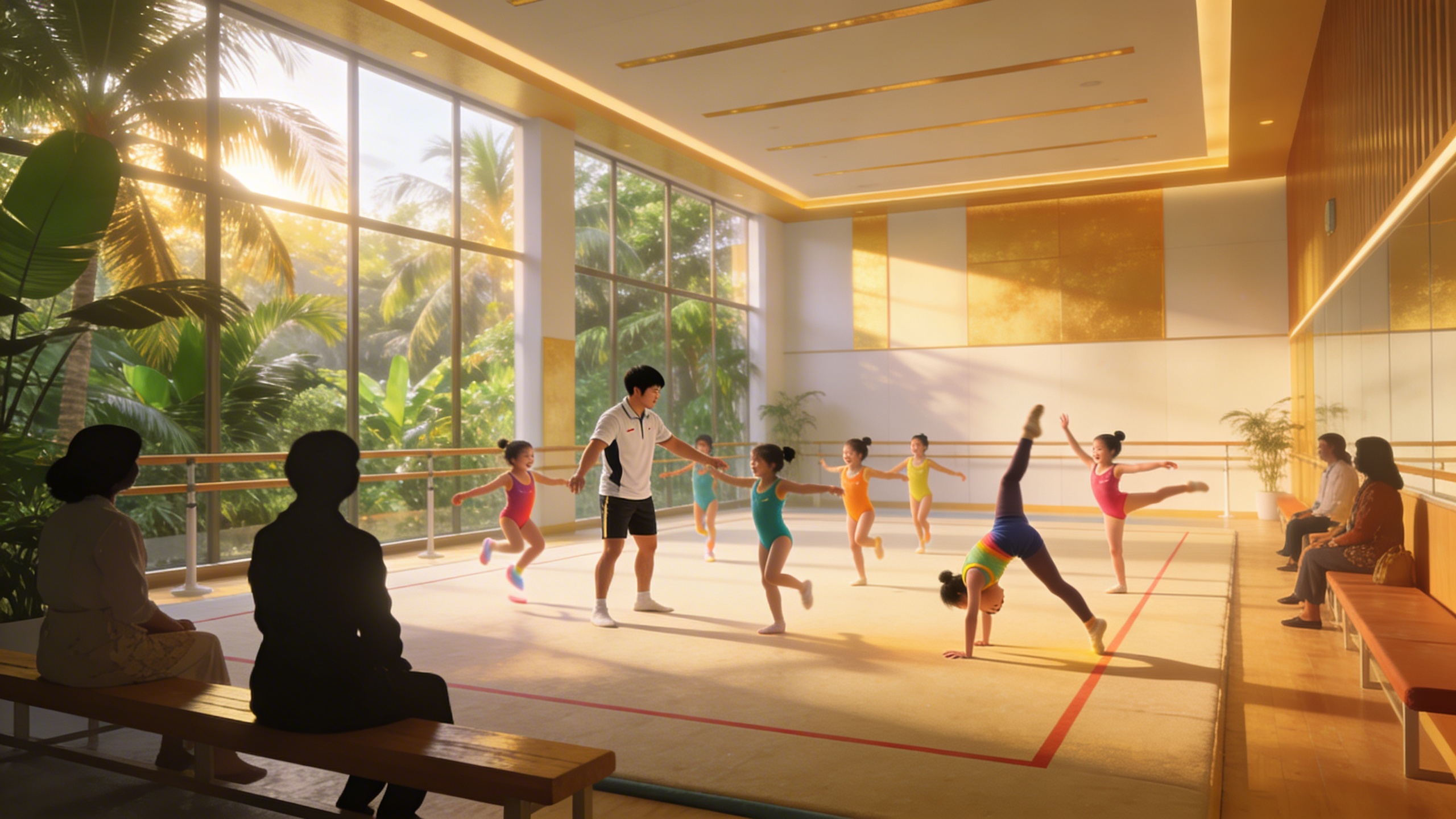
The other day, I saw news that a Japanese children’s gymnastics school called “NAIS” is expanding into Malaysia.
It might seem like just another business expansion story.
However, from the perspective of a parent practicing education migration, this is a highly suggestive move.
This is because the enrichment of a child’s “environment outside of school” can determine the quality of migration life and the child’s adaptation.
Today, using this news as a starting point, I’d like to talk about the “hidden factors” that support the success of education migration.
- Migration Life Where “School Isn’t Everything”
- The Benefits of Physical Activity, Beyond Words
- Extracurricular Activities as an Investment in Fostering “Non-Cognitive Skills”
- The Extracurricular Scene and Cost Sense in Malaysia
- Writing “After-School” into the Blueprint for Education Migration
- On Children Having Multiple “Places to Belong”
Migration Life Where “School Isn’t Everything”
When considering education migration, many people first gather information about international schools.
Curriculum, tuition fees, and university placement records are indeed among the most critical factors.
I myself spent a lot of time choosing the schools for my eldest daughter, Hikari, and my eldest son, Zen.
However, after living in Penang for over three and a half years, I’ve realized something.
That is, a child’s mental and physical stability and growth are not completed solely within school life.
Especially for younger children, how they spend their after-school hours and weekends is extremely important.
They need places to release stress from the new environment, build confidence, and make friends.
The emergence of venues like NAIS, which offer structured physical activity programs, means adding one more option to that list.
The Benefits of Physical Activity, Beyond Words
I studied physical education in university and hold qualifications as an elementary school teacher and a physical therapist.
From that perspective, I can say the role “physicality” plays in a child’s development is immeasurable.
Especially for children who have just moved abroad, they carry significant stress.
The frustration of not understanding the language, unfamiliar culture, anxiety about making friends…
Hikari and Zen also had their own struggles before settling into school.
At such times, “physical activities” that don’t rely on language become a powerful means to release stress.
Gymnastics and sports are activities where it’s easy to accumulate experiences of success.
Small achievements like “I did a forward roll” or “I held my balance longer” support a child’s self-esteem.
This can become a “mental safety net” during periods when academic results are hard to come by.
Furthermore, sports classes form a community different from school.
Even children who struggle to make friends at school often become close through shared extracurricular activities.
The fact that NAIS is implementing Japanese-style instruction overseas is also interesting.
Japanese physical play and teaching methods contain cultural elements like cooperation, taking turns, and safety awareness.
Having a place in the migration destination where children can experience the good aspects of Japan can positively influence their identity formation.
Extracurricular Activities as an Investment in Fostering “Non-Cognitive Skills”
If we view education migration as an “investment in a child’s human capital,” the investment targets are not limited to tuition fees.
So-called “non-cognitive skills” like perseverance, cooperation, self-control, and resilience (resilience) are said to greatly contribute to life success.
These abilities are fostered not just through classroom learning but precisely through experiences like sports and arts.
In Malaysia, Western-style soccer, swimming, and tennis schools have existed for a long time.
However, venues offering structured gymnastics programs for young children and elementary students, like in Japan, were limited as options.
NAIS’s expansion might be proof that this market segment is maturing and demand is being recognized.
An increase in high-quality extracurricular options in the migration destination enhances the quality of life (QOL) for the entire family.
Because parents can provide opportunities to broaden their child’s potential more easily and with greater peace of mind.
The Extracurricular Scene and Cost Sense in Malaysia
For reference, here is the general price range for children’s extracurricular activities in Malaysia (especially Penang and KL).
For group lessons, the monthly fee often falls within the range of 150 MYR to 400 MYR.
Based on the latest exchange rate information (as of March 7, 2026) of 1 MYR = 39.92 JPY, this is approximately 6,000 to 16,000 Japanese Yen.
Compared to major metropolitan areas in Japan, this is comparable or sometimes slightly cheaper.
The content varies widely, including swimming, soccer, tennis, martial arts (taekwondo, judo), music (piano, violin), ballet, art, and more.
With NAIS’s entry, “Japanese gymnastics” will be added as a new genre to this lineup.
Key points when choosing an activity are the quality of the instructor, facility safety, and accessibility.
As transportation in Malaysia heavily relies on cars, the location of the class is an important consideration.
Also, I highly recommend always taking a trial lesson.
You can directly check the chemistry between your child and the instructor, as well as the class atmosphere.
Writing “After-School” into the Blueprint for Education Migration
When planning for education migration, please also turn your attention to the environment “outside of school.”
Does the city you’re moving to have extracurricular activities or venues that match your child’s interests and characteristics?
Are public facilities like parks, playgrounds, and libraries well-developed?
These elements are often overlooked during the planning stage, but their importance grows day by day once you start living there.
Whether a child can spend their after-school hours and weekends meaningfully directly impacts the happiness of the entire family.
The expansion of companies like NAIS that provide quality programs can be seen as an indicator that the migration destination’s environment is maturing as “family-friendly” and that options are becoming richer.
This can be considered positive information for families considering education migration to Malaysia in the future.
On Children Having Multiple “Places to Belong”
Finally, I’d like to share something from my own experience.
Zen is a bit shy and took time to adjust to the new environment.
There was a period when he struggled to find his place at school.
During that time, what he looked forward to was his weekly soccer school.
The time spent chasing the ball and laughing with friends on the same team became his emotional anchor.
“Even if things aren’t going well at school, I have my place here.”
I believe that sense of security gradually made him more positive about school life as well.
For a child, a “place to belong” doesn’t need to be just one.
On the contrary, having multiple “places to belong”—like school, home, extracurricular activities, or local community—fosters mental stability and resilience.
Education migration is a journey that not only changes the place of learning but also expands the child’s world itself.
The news about NAIS was an announcement that another option to enrich that world has been added.
For those planning to migrate, I encourage you to keep an antenna tuned to such “hidden success factors” alongside your school research.
Well then, until next time.
Saori
Comments