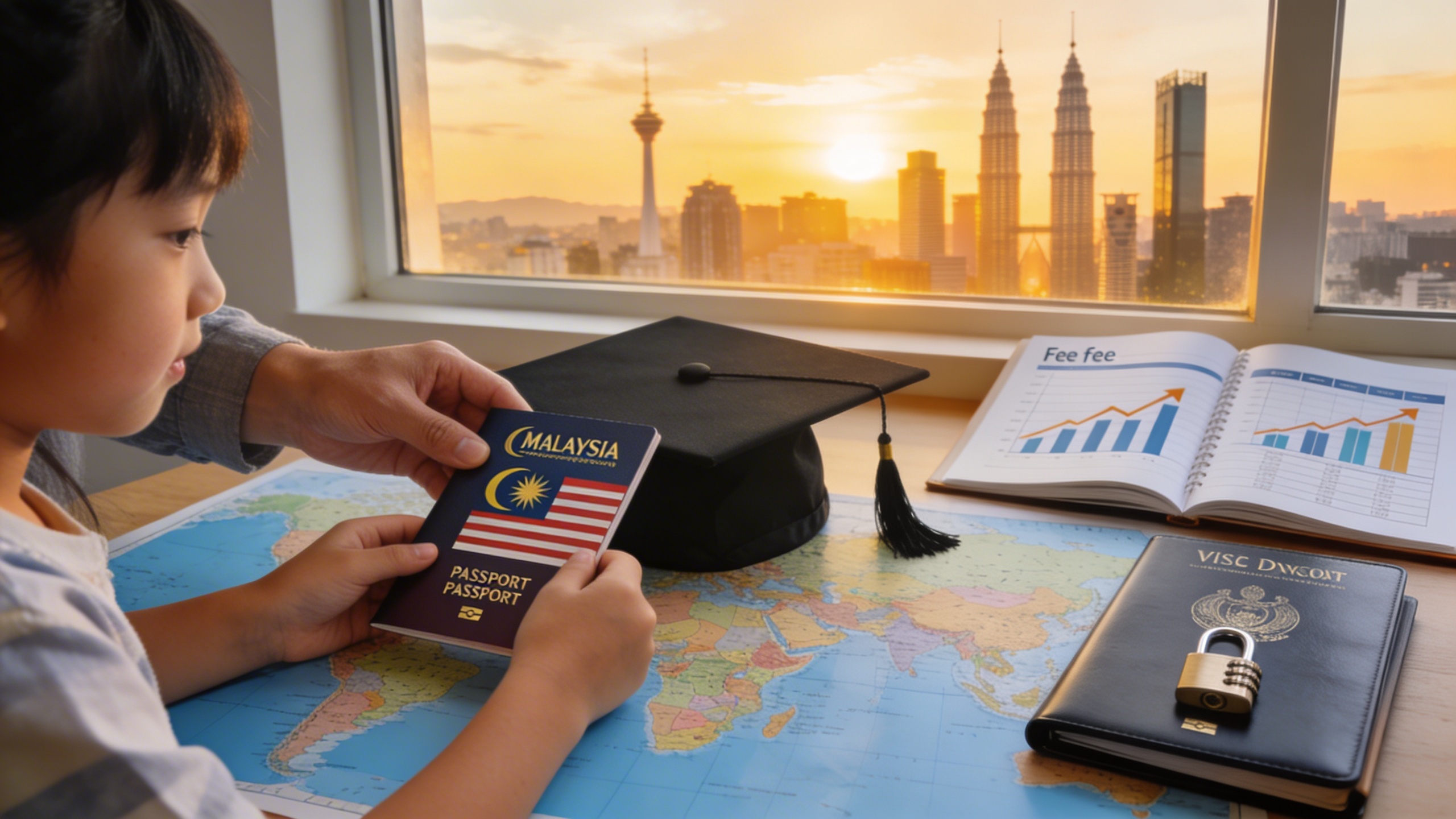
Hello. I’m Saori, in charge of our education migration media.
Recently, the most common inquiry I receive from readers is about “VISA.”
I often hear concerns like, “We want to move as a family, but we’re worried about getting a VISA.”
I strongly feel this too, through my own research and supporting families.
It has become an era where VISA strategy is essential to realizing the dream of education migration.
The Rising VISA Barrier Worldwide. Japan is Not an Exception
Haven’t you been hearing more about “VISA conditions getting stricter”?
This is an undeniable fact. First, let’s look at Japan, where we live.
Japan has also been tightening requirements for work and long-term stay VISAs in recent years.
This is just one part of a global trend.
The same is true for Canada, a popular education migration destination.
The hurdles for moving an entire family have definitely increased.
And Malaysia, once called Asia’s star student, is also moving.
The requirements for obtaining an Employment Pass have been raised.
The minimum monthly salary threshold is higher, and scrutiny is stricter.
This is not just a paperwork issue.
It’s a significant change directly linked to the very foundation of a family’s life plan.
The Double Whammy: Strong Malaysian Ringgit and Rising School Fees
Parallel to the VISA issue, another major change is occurring.
That is the rising value of the Malaysian currency, the Ringgit (RM).
Today, it finally broke through 40 yen to 1 Ringgit.
This trend is similar not only against the yen but also against the US dollar and euro.
One could say it reflects Malaysia’s economically robust position.
However, for expatriates and migrants, this is complex news.
Because it means the actual cost of living is increasing.
The area hit hardest is international school fees.
Malaysia’s international school fee structure has a particular characteristic.
Typically, the fee “tier” increases every 2-3 grade levels.
Furthermore, within each tier, the per-unit cost rises with each advancing grade.
On top of this, we now have the added impact of the strong Ringgit’s exchange rate.
For example, imagine a school with annual fees of RM50,000.
At an exchange rate of 1RM=35 yen, that was an expense of 1.75 million yen (approx. $11,700 USD).
If it becomes 1RM=40 yen, that jumps to 2 million yen (approx. $13,400 USD).
Additionally, land prices and labor costs within Malaysia are also rising.
Increased school operating costs inevitably lead directly to tuition hikes.
A situation is arising where “the fees are completely different from information from a few years ago.”
Think About Your “Exit Strategy” First
This reminds me of an article I saw on a competitor’s site that caught my attention.
“For education migration to Malaysia, where do you set your goal?”
I think this is a question that hits the nail on the head.
VISA and cost issues are, in fact, deeply connected to the “exit.”
Where do you place the ultimate educational goal for your child?
For example, are you considering “returnee entrance exams” for Japanese universities?
Or are you assuming progression to a university overseas?
This goal setting becomes the foundation for the entire migration plan.
Because it determines the type of VISA needed and the length of stay.
“We’ll figure it out once we get there” is no longer viable.
With VISA acquisition difficulty increasing, that approach is risky.
There’s a risk of the VISA expiring mid-plan, causing the education plan to fail.
It’s crucial for the family to first have a solid discussion about the “exit.”
Three Mindsets to Navigate This Era of Change
So, how should we face these changes?
From my experience and success stories, here are three key mindsets.
1. Cross-reference VISA Information with “Firsthand Accounts” and “Latest Official Info”
VISA information changes rapidly. Old information online is not helpful.
Always check the official websites of embassies and consulates.
At the same time, “firsthand accounts” from people who have actually applied locally are also important.
Details like how to fill out application forms or how officers handle cases aren’t in official guides.
Consulting with a reliable agent or local legal professional is also effective.
Think of it as an initial investment; I recommend leveraging expert help.
2. Calculate Education Funds with a “Range” that Accounts for Exchange Rate Fluctuations
Don’t estimate school fees based only on the current exchange rate.
Consider the possibility of the Ringgit remaining strong and run simulations.
For example, assume the exchange rate fluctuates within a range of 1RM=35 to 45 yen.
Calculate the total tuition fees until graduation within that range.
A safe approach is to base your financial plan on the higher end of the estimate.
Similarly, plan living expenses beyond tuition with a comfortable buffer.
3. Always Have a Flexible “Plan B”
No matter how perfect the plan, unexpected situations can occur.
Risks include not getting the VISA or a sudden sharp increase in fees.
Therefore, think of a “Plan B” separate from your main plan.
For example, if your first-choice country doesn’t work out, can you transition to a second-choice country?
Or, what about a form of “educational solo assignment” where one parent lives separately for a period?
Not limiting yourself to just one option also leads to mental peace of mind.
Summary: Update Your Information and Reconfirm Your Core Purpose
The environment surrounding education migration is definitely changing.
VISA hurdles are higher, and costs in Malaysia are rising.
However, these changes can be navigated with “preparation.”
The keys are “up-to-date, accurate information” and a “clear exit strategy.”
First, please discuss your family’s educational goals together.
Then, based on the latest information, redraw the path to reach that goal.
It may no longer be as easy or casual as it once was.
That’s precisely why more reliable information and strategic planning hold greater value.
I hope this blog serves as a helpful aid in formulating your plans.
Next time, I will talk in detail about specific examples of “exit strategies.”
Comments