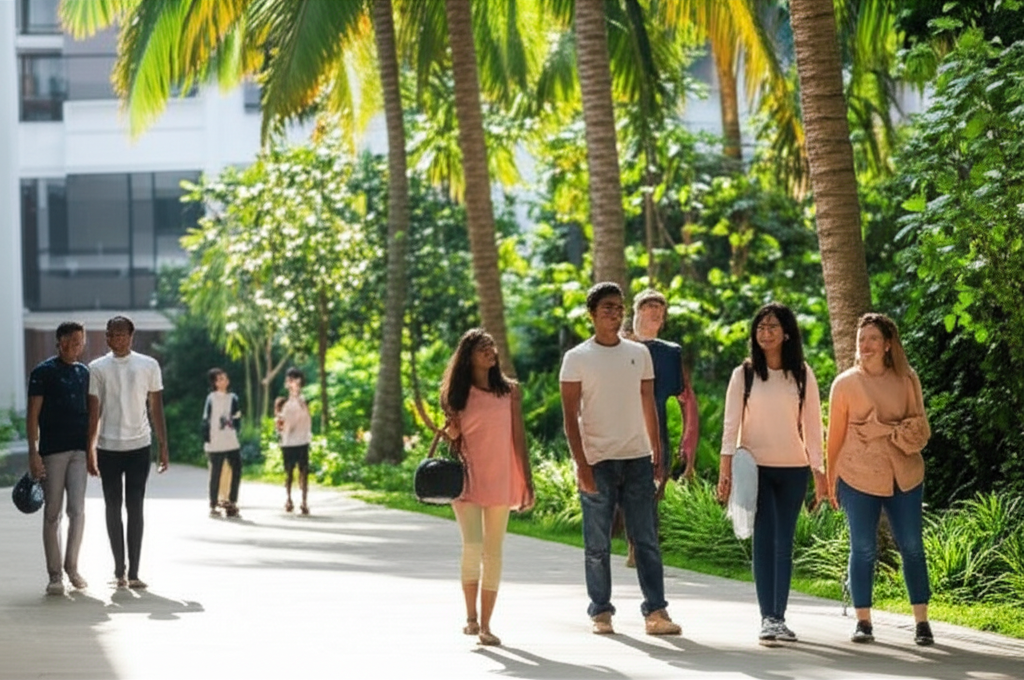
For children to adapt to an English environment, regions with lower pressure tend to be more effective, characterized by faster absorption of conversational English (BICS). Areas like Penang, which offer lower costs and easier access to dense educational opportunities, are particularly successful phases for educational migration as an entry point to English. This is because the multicultural environment helps eliminate resistance to English while making it easier to maintain Japanese.
- For children to adapt to an English environment, lower-pressure regions are more effective.
- Costs are low, making it easier to increase educational density.
- In other words, Penang is the phase with the highest success rate as an entry point to English.
- However, what is formed here is strictly “English for daily life,” not the “Academic English (CALP)” required by universities.
- This is where the value of “reverse-flow” back to Japan increases significantly.
For children to adapt to an English environment, lower-pressure regions are more effective.
The absorption of conversational English (BICS) is quick, and resistance to English naturally diminishes within a multicultural environment. Simultaneously, the relative ease of access to a Japanese-speaking environment is a major advantage, making it easier to maintain one’s mother tongue. Such a low-pressure environment is readily achievable in Malaysia, particularly in Penang.
Costs are low, making it easier to increase educational density.
Compared to Western countries, living expenses and tuition fees are more affordable. This allows families to provide their children with more enriched educational opportunities and extracurricular activities within the same budget. This is a crucial factor in increasing educational “density” and broadening a child’s potential. The high cost-performance of international schools in Malaysia is one reason they are favored by many overseas relocating families.
In other words, Penang is the phase with the highest success rate as an entry point to English.
Overall, an environment that offers low psychological and economic burden as a first step in English acquisition, while exposing children to multiculturalism and preserving Japanese, is the optimal starting point for a child. Penang, in particular, is a representative region that meets these conditions and is drawing attention from affluent individuals and families considering educational migration.
However, what is formed here is strictly “English for daily life,” not the “Academic English (CALP)” required by universities.
What is acquired here is primarily “English for daily life (BICS),” centered on everyday conversation, which must be distinguished from the advanced “Academic English (CALP)” needed for university-level lectures and thesis writing. It is important to view success at this stage strictly as building a solid foundation for the next step.
This is where the value of “reverse-flow” back to Japan increases significantly.
After establishing a foundation in conversational English in places like Penang, the value of a “reverse-flow” strategy—pursuing further education in Japan through international schools or returnee admission tracks—increases significantly. This opens a path to systematically acquire the academic English proficiency and specialized knowledge demanded by Japanese universities while maintaining and developing English practical skills. The success of educational migration can be said to lie in designing such a long-term, flexible educational roadmap.


Comments