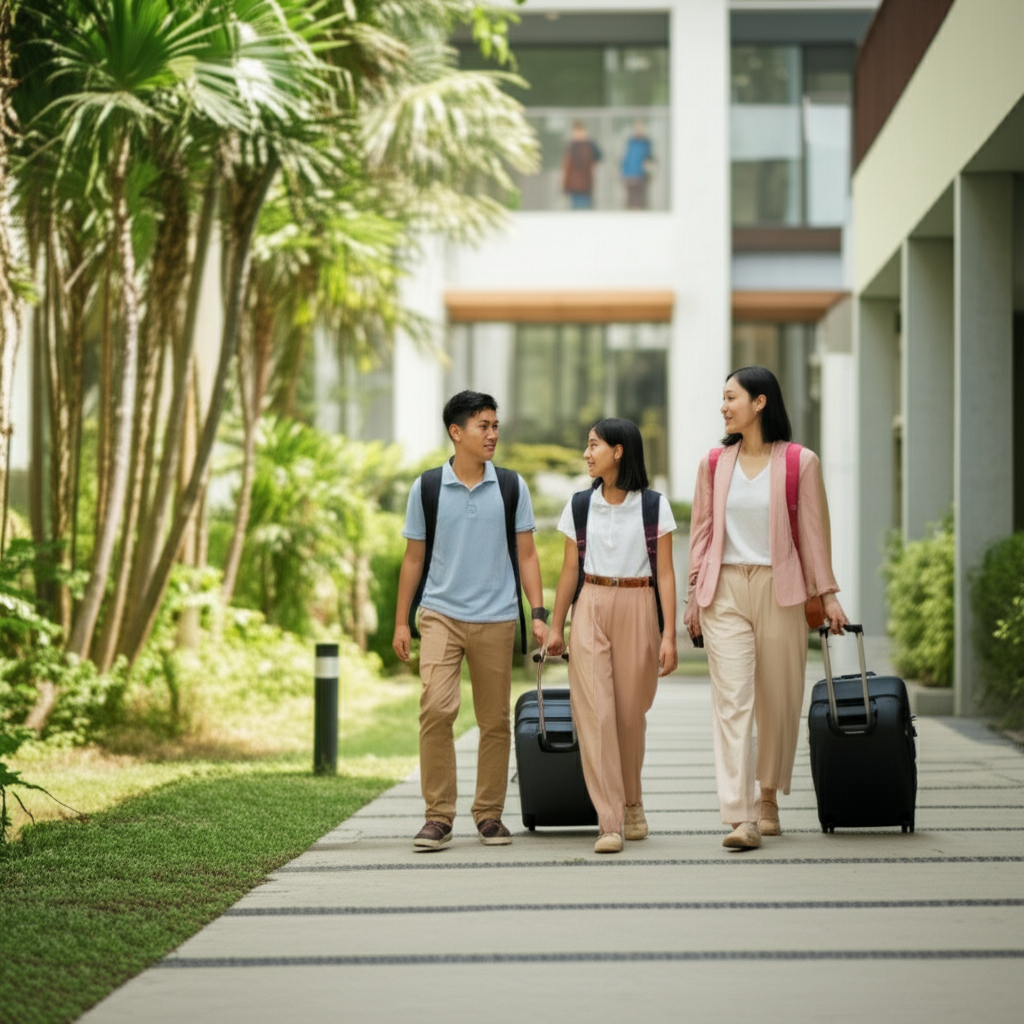
The global affluent, particularly Asian Chinese diaspora families and Western Jewish families, view “education,” “residence,” “asset building,” and “career” as a single, interconnected strategy. To continuously access the optimal city, school, and cultural sphere aligned with their child’s developmental stage, they progressively upgrade their place of residence itself. This is not a luxury, but a rational educational migration strategy designed for the long-term prosperity of the family lineage.
- ■ Why “Progressively Upgrade Your Place of Residence”?
- ① The necessary educational environment changes with each stage of a child’s development
- ② Cities have a “ceiling” for educational level
- ③ Staged relocation as risk management
- ■ Why Malaysia is Suited for Staged Upgrading
- ● Penang: The Optimal Solution for Initial Migration
- ● KL: The City for Serious Academic Competition
- ● Singapore / The West: The Final Stage
- ■ What Japan’s Affluent Often Overlook
- ■ Summary: Designing Both Residence and Education as One Portfolio
■ Why “Progressively Upgrade Your Place of Residence”?
There are three premises behind why affluent families relocate based on education.
① The necessary educational environment changes with each stage of a child’s development
In early childhood, safety, multicultural adaptation, and natural English acquisition are crucial. In middle school, a strong academic foundation and a moderately competitive environment are needed. High school demands curricula like IGCSE or IB that directly connect to university entrance. Then, in the latter half of high school, access to cities with strong connections to top overseas universities becomes key. It is difficult for a single city to fulfill all these “essential requirements.”
② Cities have a “ceiling” for educational level
No matter how much effort is made, there is an upper limit to school quality, peer academic ability and aspirations, multinational diversity, and university placement records, which varies by city. Therefore, Chinese diaspora and Jewish families adopt a strategy of switching cities when their child’s academic ability and aspirations approach that city’s ceiling.
③ Staged relocation as risk management
Japanese families tend to “bet everything on one big move,” but the global standard is the opposite. Start small and move your residence as your child progresses to each new stage. This is the method with the lowest risk and the highest return on investment (ROI) in education.
■ Why Malaysia is Suited for Staged Upgrading
Malaysia possesses an optimal structure for executing this staged educational migration strategy.
● Penang: The Optimal Solution for Initial Migration
- A calm environment and good public safety
- The relative “accessibility” of international schools
- A community scale that Japanese families find easier to adapt to
These factors provide an ideal environment for multicultural adaptation and solidifying foundational academic skills from early childhood through the first half of middle school.
● KL: The City for Serious Academic Competition
- Concentration of top-tier schools with strong university placement records, such as ISKL, Alice Smith, and Garden International School
- Established pathways from IGCSE to IB and directly to overseas universities
- A competitive, metropolitan environment where many children thrive
Kuala Lumpur (KL) is the fitting stage for the serious learning phase from the latter half of middle school through high school.
● Singapore / The West: The Final Stage
- Overwhelming university placement records to the world’s top institutions
- High-level university counseling and the intensity of entrance exam competition
- High compatibility with a family’s global asset strategy
In other words, the Penang → KL → (if necessary) Singapore / The West route is the Malaysian version of the global affluent’s “city upgrade strategy” and can be considered the most rational staircase design in educational migration.
■ What Japan’s Affluent Often Overlook
Many Japanese families tend to think, “Once decided, we should continue living there” or “Staying at the same school provides stability.” However, from the Chinese diaspora and Jewish perspective, “It is rational to change cities when the child’s educational stage changes,” and this is an action premised on the long-term prosperity of the family lineage. The most important thing for Japanese families considering educational migration is to reclaim the global standard sensibility that “changing one’s place of residence itself is a crucial educational investment that expands a child’s potential.”
■ Summary: Designing Both Residence and Education as One Portfolio
Cities have an educational “ceiling,” and the optimal city changes with the child’s developmental stage. When considering migration to Malaysia, build the foundation initially in Penang, enhance competitiveness in the mid-phase in KL, and aim for the pinnacle in the final stage in Singapore or the West. Place of residence, educational environment, and future options are inseparable. Comprehensively designing these three as one portfolio is the core of parenting strategy in the global era.

Comments