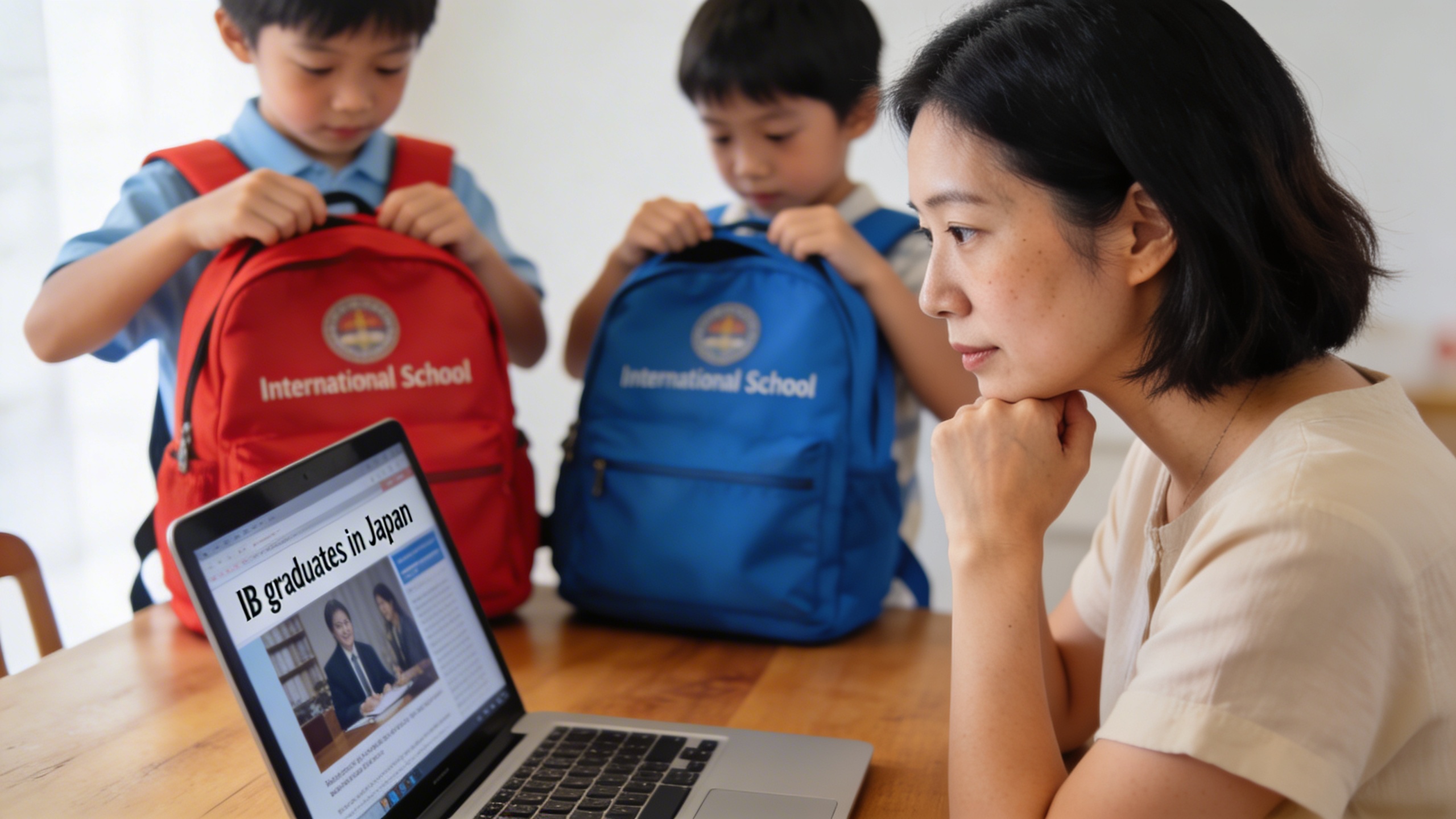
Hello. I’m Saori, a mother of three living in Penang, Malaysia.
It has been three and a half years since my eldest daughter, Hikari, started attending an international school. Recently, during a parent-teacher conference, her teacher said something that left a deep impression on me: “Hikari accepts her classmates’ diverse cultural backgrounds and ways of thinking as a matter of course and deepens her learning from them. This is one of the most valuable skills children acquire growing up in this environment.”
Hearing this, I was struck. When we first decided on education migration, we focused on the “visible” benefits like English proficiency, an international curriculum, and cost-effectiveness. However, I’ve come to feel that what our children are truly gaining through their daily school life is something even more profound: “adaptability within diversity.” It’s an asset that’s hard to quantify but may be the most crucial one needed in the society of the future.
The Days When the Concept of “Normal” Melts Away
At the international school in Penang that my children attend, it’s normal for a single class to have children from over ten different nationalities. Skin colors, languages spoken, family religions, and celebrated holidays are all incredibly diverse.
The other day, my five-year-old son, Zen, came home from school and happily reported, “Today, I ate a Deepavali feast at my friend’s house! It tasted totally different from mom’s cooking, but it was really delicious!” For him, experiencing a different culture’s food at a friend’s house isn’t a special event; it’s just one of the fun, everyday occurrences.
My eldest daughter, Hikari, has had deeper realizations. Her best friend is half-Korean and half-Malaysian. One day, that friend mentioned, “On weekends, I go to both my grandpa’s (Korean) house and my grandma’s (Malaysian) house.” Hikari secretly asked me, “Don’t grandparents usually live in one house together?” It was a moment when her concept of a “normal family” was shaken by her friend’s reality.
This kind of daily “exposure to diversity” is on a completely different level from learning about intercultural understanding from a textbook. On an instinctive level, children absorb the fact that there are many different versions of “normal” in the world.
Adaptability is the Source of “Problem-Solving Skills”
This adaptability to diversity is more than just sociability or “being able to get along with people.” As a former elementary school teacher and now a mother of three, I believe the essence of this ability is directly linked to “problem-solving skills in uncertain situations.”
Let me give a concrete example. In Hikari’s class, group projects are frequent, and the members change each time. Sometimes a naturally leading child takes the center, while other times everyone collaborates and shares ideas. Occasionally, small misunderstandings arise due to language barriers or differences in communication styles.
However, the children learn to摸索 for ways to engage that suit each situation. “Maybe explaining with a drawing will work better for this friend.” “That friend seems uncomfortable with loud talking, so let’s try speaking from a bit farther away.” These micro-adjustments aren’t taught by the teacher; they are skills the children acquire through their own trial and error.
This is precisely the core competency needed in the future society, often described as the VUCA (Volatility, Uncertainty, Complexity, Ambiguity) era. It’s the ability to forge one’s own path within changing environments and diverse human relationships, not just following a given manual. The environment of education migration naturally integrates this into a child’s daily life.
Diversity Adaptability as an “Investment”: Value Beyond Exchange Rate Risk
When considering education migration, cost is a concern for many. Exchange rate fluctuations are indeed a factor. According to the latest exchange rate information (as of March 11, 2026), 1 Malaysian Ringgit (MYR) = 39.98 JPY. Compared to a few years ago, the impact of the weak yen is not insignificant.
For those of us paying tuition and living expenses in Japanese yen, this is certainly an increased burden. However, I’d like you to consider the long-term value of the asset children are acquiring in this environment: “diversity adaptability.”
This differs from “hard skills” that directly translate to future career income. Rather, it’s a “meta-skill”—the ability to create value in any environment and with any group of people. I am convinced that in a future where AI advances and many routine tasks become automated, this uniquely human adaptability and co-creation ability will become increasingly rare and valuable.
The education our parent generation received largely centered on “finding the right answer” in a relatively homogeneous environment. But the world our children will live in has no single right answer, and their collaborators will be diverse. The foundation for thriving in that world is being built practically every day in the “miniature Earth” of a Malaysian international school.
How to Nurture the Seeds of “Adaptability” at Home
Of course, this ability doesn’t depend solely on the school environment. How we engage at home also has a significant impact. Let me share a few things our family consciously does.
First, we make a point to “listen” to our children’s school experiences without immediate judgment. When Zen said, “My friend’s home food had a weird taste,” instead of scolding him with “That’s rude to call it weird,” we ask with interest, “What did it taste like? Was it spicy? Sweet?” Feeling that a cultural experience is “weird” is natural. What’s important is supporting the process of not stopping their thinking there but turning that difference into an object of curiosity.
Next, we actively talk about the “good points” of both Japan and Malaysia. During Tsukimi (moon-viewing), we celebrate the Japanese tradition, and during Deepavali, we go together to look at the decorations at our Indian neighbors’ homes. We consciously weave a pluralistic perspective into our daily conversations—not a binary of “this is right, that is wrong,” but “the world has so many wonderful customs.”
Finally, we value our children’s “sense of dissonance.” Hikari feeling that “my friend’s family structure is different from my ‘normal'” was a very healthy realization. Helping to升华 that sense of dissonance through dialogue into an understanding that “that’s another way a family can be”—this assistance from parents might be the greatest support we can provide at home.
The Invisible Asset That Will Open Up the Future
When considering the return on education migration, it’s easy to focus on tangible outcomes like “which university did they get into?” or “what score did they get on the English test?” I was like that myself in the beginning.
However, after three and a half years of living here, what I find most reassuring in my children’s growth are the parts that can’t be measured by such “scores.” Zen’s curiosity to dive into unfamiliar environments without hesitation. Hikari’s consideration in trying to balance herself and others within complex human relationships. Even my one-and-a-half-year-old second daughter, Yukari, smiles at other children in the park, regardless of nationality, amidst a flurry of different languages.
This “diversity adaptability” doesn’t blossom immediately. Like roots growing steadily underground, it’s an asset that develops within a child. Before getting caught up in the short-term cost fluctuations of exchange rates or tuition hikes, I hope you can also hold the perspective that this is an investment in a long-term, irreplaceable asset.
What will enable us to thrive in an uncertain future is not uniform knowledge, but the ability to adapt flexibly to change and create value together with diverse people. I feel this truth daily: Malaysia’s educational environment provides the rich soil for nurturing that very ability.
Comments