Hello. I’m Saori, living in Penang, Malaysia, and raising three children.
When discussing education migration, the focus tends to be on the children. Their adaptation is certainly important. However, after three and a half years of living here, I’ve realized something. What truly determines the success of migration might actually be “the parent’s own ability to keep learning.”
This time, let’s consider education migration from the perspective of “parental re-learning.”
- An Environment Where Parents Learn More Than Their Children
- Shifting from “Teaching Parent” to “Learning-Together Parent”
- In Practice: The 3 Pillars of My “Parental Learning”
- To Our Entrepreneur Readers: Redefining Leadership
- Concrete Steps to Continue Learning
- The True ROI of Education Migration Lies in Parental Growth
- In Conclusion: Education Migration is a Growth Story for the Whole Family
An Environment Where Parents Learn More Than Their Children
My eldest daughter, Hikari, and eldest son, Zen, attend an international school. They learn and play in English every day, adapting to their environment at an astonishing speed. But what about us, the parents?
When we first moved, I faced a huge wall. All communication from the school was in English. Parent-teacher meetings were conducted in English. Making local friends also required English. Children’s adaptability is wonderful. However, if parents don’t learn, we cannot become the bridge between home and school.
I acquired business-level English here in Malaysia. Now I handle company incorporation and business negotiations in English. Without this skill, my current life wouldn’t be possible. Education migration is also an “opportunity for learning” for parents.
Shifting from “Teaching Parent” to “Learning-Together Parent”
Having obtained a Japanese elementary school teaching license, I initially had a strong “teacher” mindset. But life in Malaysia changed that. Here, there is so much for parents to learn from their children.
Hikari told me about an environmental project she learned at school. Her explanation updated my own knowledge. The cultural differences Zen learned through interactions with his friends challenged my preconceptions. The assumption that parents know everything doesn’t hold up here.
Instead, an attitude of “let’s look up what we don’t know together” is crucial. This attitude further nurtures a child’s curiosity. Education migration becomes an opportunity to shift the parent-child relationship from “hierarchical” to “co-learning.”
Latest Exchange Rates and Investing in Learning
Parental learning also requires investment. Costs for language schools or online courses, securing time, and so on. Exchange rates are a key factor.
According to the latest exchange rate information (as of March 8, 2026), 1 Malaysian Ringgit (MYR) is 40.01 Japanese Yen. Based on this rate, learning costs locally are often lower than in Japan. You can find high-quality private English lessons starting from around 2,000 yen per hour. This can be considered an investment in parental growth.
Children’s tuition isn’t the only educational investment. Parents learning and growing in an international environment. This boosts the entire family’s “human capital.”
In Practice: The 3 Pillars of My “Parental Learning”
As a parent, I strive to keep learning based on the following three pillars.
The first is “Language and Communication.” To speak equally with school teachers and other parents, I work on maintaining and improving my English. The second is “Local Culture.” I learn about Malaysian holidays and customs to understand my children’s daily lives. The third is “Global Education Trends.” I keep up with the latest information on the IB curriculum and university admissions worldwide.
My second daughter, Yukari, is only one and a half and not yet in school. By the time she starts, the world will have changed even more. If our learning as parents stops, we risk narrowing our children’s future options.
To Our Entrepreneur Readers: Redefining Leadership
I understand many readers of this media are entrepreneurs. In your company, as a leader, you might be in a position to grasp everything and give instructions. However, in the project of family education migration, a slightly different kind of leadership is required.
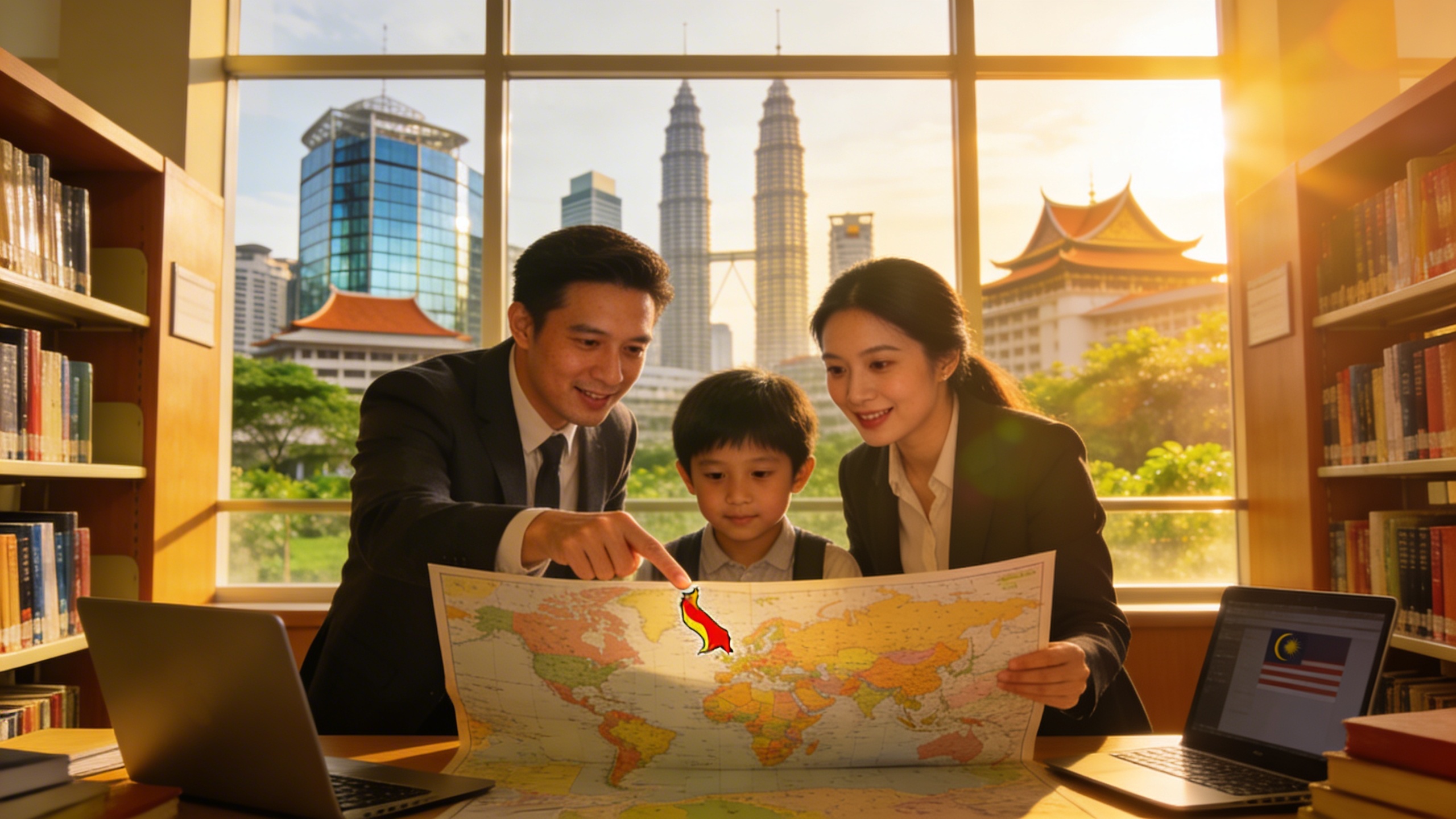
It’s leadership that “learns together and shows direction.” In an unknown environment, parents are also beginners. An attitude of spreading the map and finding the way together with your children is vital. I believe this experience also cultivates your ability to handle uncertainty in business.
Having established and run my own company here in Malaysia, I’ve keenly felt how important this “progress while learning” mindset is. Education migration is also an opportunity to update a parent’s leadership style.
Concrete Steps to Continue Learning
So, how should parents continue learning? Let me share a few practices from my experience.
First, set small goals. Start with achievable goals like, “This month, I’ll read the school newsletter without a dictionary.” Next, dive into the local community. Volunteering for parent-teacher association events naturally increases learning opportunities. Finally, treat your child as a teacher. Have them explain what they learned at school. This becomes the best learning opportunity.
The important thing is not to seek perfection. Not fearing mistakes and maintaining a learning attitude itself becomes the best message for your children.
The True ROI of Education Migration Lies in Parental Growth
When considering the Return on Investment (ROI) of education migration, we tend to look only at children’s future schools or tuition fees. However, in the long term, the value brought by the parents’ own growth is immeasurable.
Parents who have enhanced their problem-solving skills in an international environment. Parents who have broadened their perspective to embrace diversity. Children raised watching such parents’ backs naturally acquire a global sensibility. This is an asset that money cannot buy.
It’s been three and a half years since our family came to Penang. Of course, I’m delighted by the children’s growth. But I also feel that I myself have undoubtedly grown compared to my former self. This confidence and breadth of perspective are things I likely wouldn’t have gained if I had stayed only in Japan.
“Parental Learning” Also Applies to Exit Strategies
This media also emphasizes the importance of exit strategies. Parents continuing to learn and understand the environment leads to making the best exit decisions. By deeply understanding local information, you can calmly judge what is truly suitable for your family.
Conversely, if parents do not try to learn the local language or culture and become isolated from their child’s environment, dissatisfaction will only accumulate. It also becomes impossible to make a timely exit decision. Parental learning is essential not only for success but also for a wise exit.
In Conclusion: Education Migration is a Growth Story for the Whole Family
To everyone considering education migration. Choosing your child’s school and calculating costs are important. But equally, please ask yourself, “What can I, as a parent, learn in this environment?”
Life in Malaysia has given me many insights. Holding both a teaching license and a physiotherapist’s perspective, I now learn daily as an “eternal student.” Hikari and Zen’s stories from school are a treasure trove of learning hints for me. By the time Yukari grows up, I hope to still be learning.
The success of education migration cannot be measured by children’s smiles alone. Isn’t true success when the entire family builds a relationship of growing and learning together? That is the irreplaceable return on an investment that cannot be expressed in numbers.


Comments